Back to Top


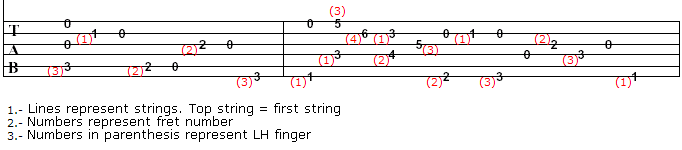
Bach, "Air on the G String" (TAB)
Transcription and Fingering: Renato Bellucci
Technical-Musical Challanges:
Changes of LH presentation, Counterpoint, Chords, LH Stretch, Pivot, Legato.
One of the best known Baroque suites for orchestra is Suite No. 3 by Bach. The orchestra consists of strings (first violins, second violins, violas, and cellos, with double basses doubling the cello part), keyboard, two oboes, three trumpets, and timpani. The addition of trumpets and timpani gave rise to the term festival orchestra. The keyboard player was the leader of the orchestra, and normally the other musicians sat on either side of that instrument.
The second movement of the suite is an air. Like an aria, an air is melodious. This one contains some of Bach's most beautiful writing. It can be referred to as "THE" air. The movement is widely known as Air for the G String, so named after an arrangement for solo violin. The arrangement was done not by Bach but by a nineteenth century violinist.
In the original version of the Air, the first violins play a gentle melody:
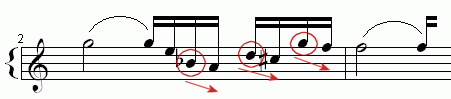
The third measure (staff 2 above) in the example begins with a long G. Its motion swings down and back up again. The interest of the melody is increased through the repeating of a two-note descending figure at successively higher pitch levels. To emphasize the pattern further, rhythmic stress is felt on the circled notes. The same pattern is repeated in the next measure, but one note lower.
The musical success of the Air lies as much in the other parts as it does in the melody itself. The second violin and viola lines weave together effectively with the melody. The motion of one tends to answer the motion of another. When the melody sustains a long tone, another part usually has a moving figure. Cellos and basses outline the chords in simple eighth notes. The line sounds almost as though it were walking gently, first moving down the scale and then easing its way back to where it started.
Rather than repeat each pitch at the same level, Bach writes the second note to sound an octave either higher or lower, a simple technique that adds just the right amount of interest.
In fact, the whole work is simple, so superbly simple. Bach creates a mood of serenity and yet adds enough motion to hold the listener's interest. This music illustrates the manner in which a great composer uses the usual patterns of chords and notes and adds to them the proper proportion of change and imagination.
In some respects Bach's Suite No. 3 is not typical of the form. Only one of its dances, the gigue, was a standard component in the average suite. Furthermore, the work was written for orchestra instead of for a keyboard instrument.
If I could only play one piece, the Air would be the one.
"Air On the G String", Oct 23, 2014
Add to playlist
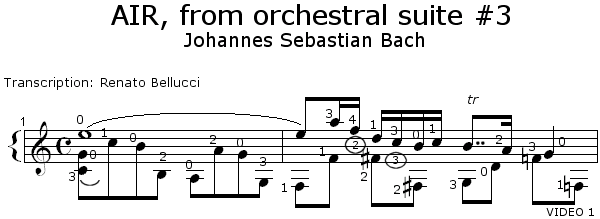
Staff and Video 1
Analysis:
Assign a RH finger to each string. Notice how he arm helps the finger in stopping the low F. BACH was the master at "voicing". He could make 2, 3 or 4 parts move simultaneously with amazing artistry and knowledge. In the air you will have mainly 2 voices moving and he literally squeezes them to the maximum and the resulting masterpiece is without any doubt one of the greatest pieces of music ever written.
Video 1
The continuation of this masterclass is in the members area, become a member today.