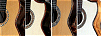

Model: BR-CS-1: Brazilian Rosewood Back and sides, Curly Sinker Redwood
top Curly
sinker Redwoods are the greatest trees recovered to date. Some of the logs
are 4 meters thick in diameter. Curly Redwood trees were around when Dinosaurs
roamed the Earth and, just like their animal counterparts, they were literally
gigantic. The trees had to be logged and worked extensively in the spot
where the trees were logged. Water ways would then transport the wood to
the wood mills. The sound that these woods put ot is unbelievably deep
and mature. The clarity, perfect separation of voices and the second to
none sustain, put these giants in a league all of their own. The counterpoint
in the Air by Bach is well marked and the singing voice clear and
penetrating. Sustain and harmonic overtones are superb.
Coupled with 12o years air dried
beautifully figured and bookmatched Brazilian Rosewood, allows me to create
some of the best concert guitars ever. Playing this beauty is a wonderful
experience and I feel as though se has no limit when it comes to expressiveness
and width of tone colors available to my fingertips.
Decorating her was done making sure
that she looks her best from every angle. Bindings and purfling alone take
30 hours to be made. Her playability is perfect and she would be a dream
come true for any guitar player looking for the guitar of a lifetime.
US$ 3,890 DHL
Shipping:
USA 184 USD,
Europe
and Africa 223 USD, Asia and Oceania 278 USD
The fan brace is based on the Hauser
1943 Frame. It incorporates 4 different species of wood: Sinker redwood,
Spruce, Cedar and Mahogany. The sinker Redwood is the transversal strut
that shortens the trebles side to augment the power of the high registers
whilst Cedar and spruce were used on the bass side to augment the power
of and resonance of the bass line. I think I can affirm that she has the
most powerful 6th string I have ever heard and one of the best ringing
trebles you can hope for. Simply amazing. The top was reduced to less than
1 mm towards the edges and just a little over 1 mm towards the bridge area
where I installed a new underbridge system that connects the bridge with
each strut in the fan brace whilst directing each frequency to the right
portion of the top.
Sinker logs, are pulled from
the bottom of lakes and rivers.
Sometimes, scuba divers are needed
to achieve the extraction. Most of these logs
are hundreds of years old (In one
of the pictures above, you can see that the tree was
cut with an hatchet). Due to a series
of factors (The logs were too big and heavy to be
pulled out of the rivers or the
logs were caught by currents and were sucked to the
bottom) these logs were trapped
by the muddy buttons of these water beds and this
created like a time capsule where
the wood was preserved in fantastic humidity
conditions that made the wood season
in a slow natural way during many centuries.
Some of the logs are selected for
musical instruments construction. The sound that
these woods produce is unique and
the grain has a beautiful coloration that changes
according to the type of mud present
in the water bed.
Request the signed poster
Radiused or flat fingerboard? The radiused fingerboard has been
around the acoustic and the electric guitar since day one. The same is
true for most instruments of the Stringed family of instruments (violas,
violins cellos, bass). Radiusing (image above) makes barre and left hand
stopping A LOT easier. The only drawback is that you will NEVER want to
play a flat fingerboard after that. If you are having your custom
guitar built, I am all pro radiusing the fingerboard. The standard
fingerboard is flat.
650
mm or 640 mm? Keep the following
rule at hand: If the distance between the tip of your thumb and the tip
of your little finger is equal or less than 9 in. when fully stretched,
use 640 mm. In stringed instrument performance, a single millimeter can
mean the difference between playing effortlessly or the exact opposite.