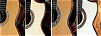
Model: BR-C-TT: Brazilian
Rosewood Back and sides, Cedar top. 640mm "The
Tiger Guitar"
Here
is a TREMENDOUS masterpiece to make this one of the most rewarding years
in Bellucci guitars history. This TIGER is a SUPREME work of art and the
amazing set of Brazilian Rosewood I received from Cascavel in Early August
inspired me to build a new "feline" masterpiece... I added every possible
construction and acoustic element hat I've perfected in all these years
and she paid back delivering one of the most terrific sounds I ever heard.
Powerful, yet sweet and profound with reverberating basses and clear as
a river stream trebles... Pernambuco's Chorinho is lively and gains in
expressiveness on this magnificent instrument. The beauty of the grain
is beyond words...the perfect selection of woods to care every single detail
add up to the completeness of the work... Ebony in the bindings, bridge,
violin tie... A gorgeous Cedar top. The special cut gives her the ease
of play of a cutaway but adds beauty and art to her lines...the elevated
fingerboard enhancement make her easy to play and push her sound to be
the fullest and most beautiful possible. Your eyes will find beauty and
art in every piece of the construction and this TIGER masterpiece is without
a doubt one of the most beautiful guitars EVER...at a ridiculous price...
|
..


As seen above
USD 3,950
DHL
Shipping:
USA 184 USD,
Europe
and Africa 223 USD, Asia and Oceania 278 USD
|

Radiused or flat fingerboard?
The radiused fingerboard has been
around the acoustic and the electric guitar since day one. The same is
true for most instruments of the Stringed family of instruments (violas,
violins cellos, bass). Radiusing (image above) makes barre and left hand
stopping A LOT easier. The only drawback is that you will NEVER want to
play a flat fingerboard after that. If you are having your custom
guitar built, I am all pro radiusing the fingerboard. The standard
fingerboard is flat.
|

650 mm
or 640 mm?
Keep the following
rule at hand: If the distance between the tip of your thumb and the tip
of your little finger is equal or less than 9 in. when fully stretched,
use 640 mm
.

The double top with the 9 braces
Hauser fan, was developed and introduced by Master Luthier Manuel
Contreras the II at the end of the 70s and reached its peak in the 80s.
In this Variation of the Double top, a second top is located halfway between
the main top and the back. It is held in place by means of little Mahogany
bridges located above and below the second top along the inner part of
the sides (frames 1 & 3). The second top rests on the upper bridges
and once it is glued on each little bridge (frame 2), a second bridge is
glued on top of the preceding corresponding bridge below the second top
(frame 3). This second top vibrates a fraction of a second after the first
one creating an immense sustain and punch using the air moving inside the
sound box and thus creating a multiplying effect of the sonorous waves. |

Sinker logs (top #2), are
pulled from the bottom of lakes and rivers. Sometimes, scuba divers are
needed to achieve the extraction. Most of these logs are hundreds
of years old (In one of the pictures above, you can see that the tree was
cut with an hatchet). Due to a series of factors (The logs were too big
and heavy to be pulled out of the rivers or the logs were caught by currents
and were sucked to the bottom) these logs were trapped by the muddy
buttons of these water beds and this created like a time capsule where
the wood was preserved in fantastic humidity conditions that made the wood
season in a slow natural way during many centuries. Some of the logs are
selected for musical instruments construction. The sound that these woods
produce is unique and the grain has a beautiful coloration that changes
according to the type of mud present in the water bed.

.
.
.
|
Request the Signed POSTER
23.6 in X 51 in

|
|