Model: AB-S-1: African
Blackwood Back and sides, Sinker Redwood
top
.
Sinker logs, are pulled from
the bottom of lakes and rivers.
Sometimes, scuba divers are needed
to achieve the extraction. Most of these logs
are hundreds of years old (In one
of the pictures above, you can see that the tree was
cut with an hatchet). Due to a series
of factors (The logs were too big and heavy to be
pulled out of the rivers or the
logs were caught by currents and were sucked to the
bottom) these logs were trapped
by the muddy buttons of these water beds and this
created like a time capsule where
the wood was preserved in fantastic humidity
conditions that made the wood season
in a slow natural way during many centuries.
Some of the logs are selected for
musical instruments construction. The sound that
these woods produce is unique and
the grain has a beautiful coloration that changes
according to the type of mud present
in the water bed.
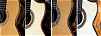
As seen here:
3,999 USD DHL
Shipping:
USA 184 USD,
Europe
and Africa 223 USD, Asia and Oceania 278 USD.
The 9 braces Hauser fan is
the most thoroughly tested fan brace setup on the planet. It is the result
of many years of experimenting. It is braced on Torres 4 fan brace design.
The braces act as sound vibrations highways...they carry the vibration
of each string to a specific spot on the soundboard. If you put your fingers
on the soundboard as you play the 6th string for instance, you will feel
the upper portion of the top vibrate with more power than the rest of the
top. You will be able to feel this vibrations with your fingertips
all the way to the 4th strings. It is harder to feel the vibration caused
by the treble strings. The variations on the 9 braces fan is enormous.
Luthier taylor each fan to achieve a specific sound and match the instrument
with the rest of the woods used in the construction. Above to the left
is a 9 braces all Spruce fan. I often use a mixture of Cedar, Spruce and
Mahogany to match different wood combinations.
650
mm or 640 mm? Keep the following
rule at hand: If the distance between the tip of your thumb and the tip
of your little finger is equal or less than 9 in. when fully stretched,
use 640 mm. In stringed instrument performance, a single millimeter can
mean the difference between playing effortlessly or the exact opposite.









 650
mm or 640 mm?
650
mm or 640 mm?