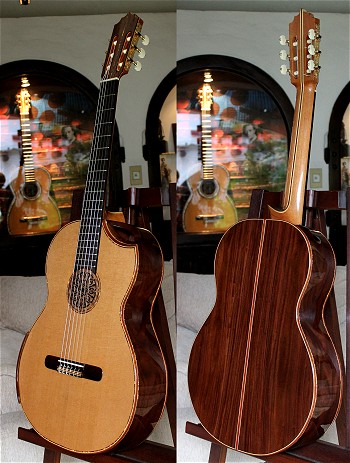
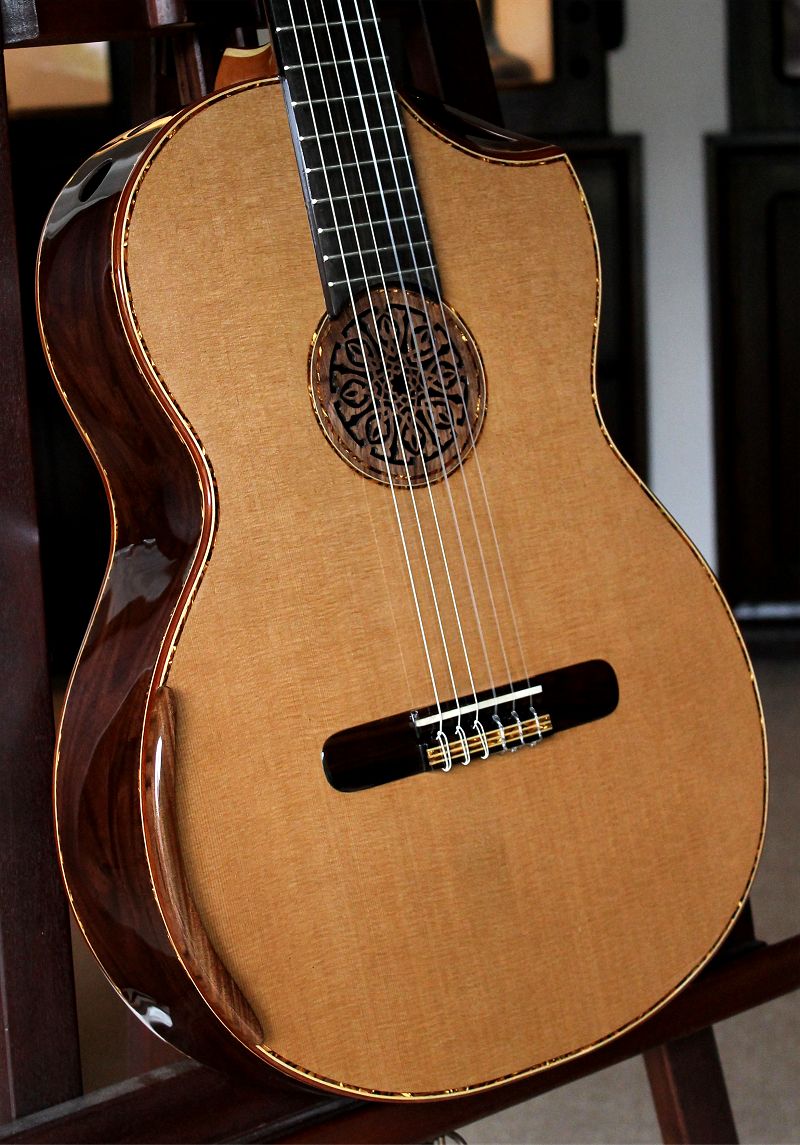
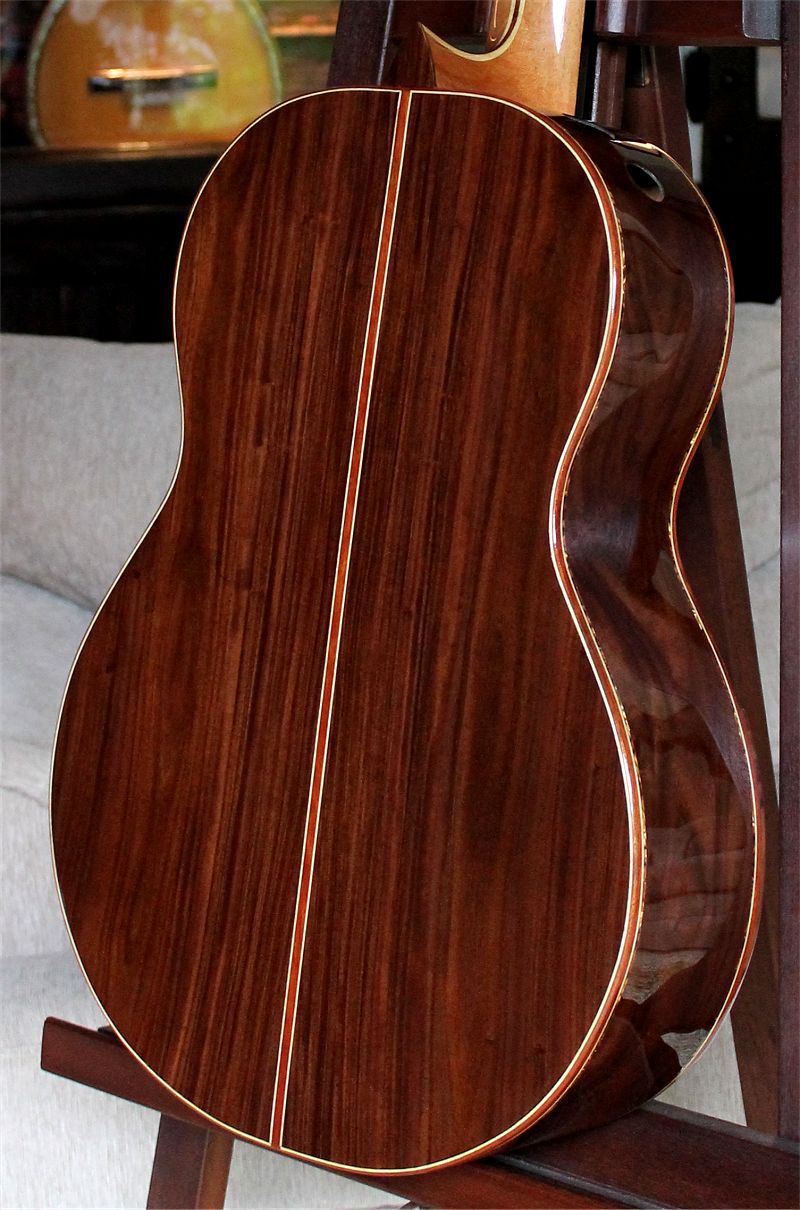
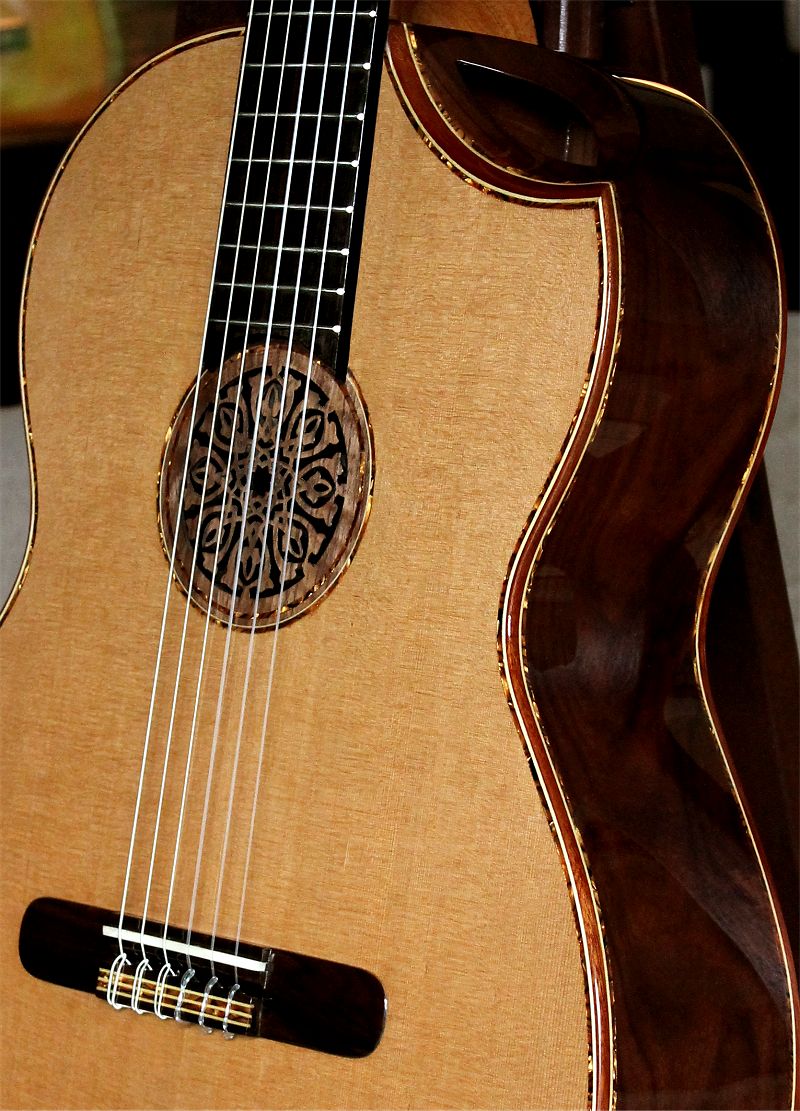
Model: BR-C-LT": Brazilian
Rosewood Back and sides&S, Cedar top Concert guitar
Da Vinci Series
..
.
.
.
USD 3,700 DHL
Shipping:
USA 184 USD,
Europe
and Africa 223 USD, Asia and Oceania 278 USD
The fan brace is based on the Hauser
1943 Frame. It incorporates 4 different species of wood: Sinker redwood,
Spruce, Cedar and Mahogany. The sinker Redwood is the transversal strut
that shortens the trebles side to augment the power of the high registers
whilst Cedar and spruce were used on the bass side to augment the power
of and resonance of the bass line. I think I can affirm that she has the
most powerful 6th string I have ever heard and one of the best ringing
trebles you can hope for. Simply amazing. The top was reduced to less than
1 mm towards the edges and just a little over 1 mm towards the bridge area
where I installed a new underbridge system that connects the bridge with
each strut in the fan brace whilst directing each frequency to the right
portion of the top.
.
.
Request the signed poster
.
.
650 mm
or 640 mm? Keep the following
rule at hand: If the distance between the tip of your thumb and the tip
of your little finger is equal or less than 9 in. when fully stretched,
use 640 mm
Radiused or flat fingerboard? The radiused fingerboard has been
around the acoustic and the electric guitar since day one. The same is
true for most instruments of the Stringed family of instruments (violas,
violins cellos, bass). Radiusing (image above) makes barre and left hand
stopping A LOT easier. The only drawback is that you will NEVER want to
play a flat fingerboard after that. If you are having your custom
guitar built, I am all pro radiusing the fingerboard. The standard
fingerboard is flat.