|
How to choose
the strings for your classical guitar
I have read all types of information
on the issue and, to be quite frank, I must say that if I were to choose
the right set of strings for my classical guitar based o the information
found online, I'd be quite puzzled to say the least.
What I write below is based on my
experience based on 40 years playing the classical guitar, teaching how
to play it and building concert guitars.
This are the main rules:
1- All strings priced between 6 and
30 US$ are the same from a practical point of view.
2- It is preferable to change 5
bucks strings every month than leave 20 US$ strings on for ages...
When the string are new, you must
absolutely avoid using them in concert or recording. In case you must use
new strings, pass the bass strings in 2000 grit sandpaper in order to remove
the excessive abrasiveness that causes unnecessary string squeaking. Hold
the sandpaper in one hand, pull the string from one extreme in the folded
sheet of sandpaper. Do this 3-4 times for each bass string.
STRING TENSION
Strings must be low or normal tension
to allow for a sweet sound and beautiful vibratos. The higher tensions
are only recommended for flamenco style playing or for people who uses
extremely low actions. High tension strings should only be used by players
who have a beautiful round sound or else the sound will be harsh and poignant.
If your nails are thin or break and peel easily, use low tension strings.
If you use high tension strings, you must use short fingernails or else
the fingernail clipping against the nylon surface will be unbearable..
ACTION and string buzzing
The rule of thumb here is: it is
preferable to play on a low action that may have a buzz here and there
than on a buzz free high action. Most pros work around buzzes. A knowledge
of the instrument is all it takes to work around buzzes. The best action
should be kept between around 3.5mm at fret 12 (measure from the top of
the fret to bottom of string). Some players find 3 mm to be perfect. This
height will probably cause a few buzzes, but the ease of play is
worth it. You will have to adjust plucking strength on some notes. Most
people who complain about difficulty in barring are probably using an action
that is too high. Even when they are able to play the barre, the amount
of strain will make the left hand tired in no time. Lower the action !
Scale lenght
Regarding 650mm or 640 mm guitar
construction, keep the following rule at hand: If the distance between
the tip of your thumb and the tip of your little finger is equal or less
than 9 in. when fully stretched, use 640 mm (image below). In the many
years teaching and playing the classical guitar and having worked closely
with such great teachers as the Spaniard Jose Tomás and the Uruguayan
Abel Carlevaro, it came clear to me that often hard to polish musical passages
were not the fault of the player but a fault of the scale used for the
fingerboard. Modern guitar construction is no longer dependent on scale
length to produce a substantial volume. When we talk about scale length
we are talking to the relative distance of the frets from one another...
we are talking millimeters or fraction of a millimeter, but it is these
fractions that make all the difference between flawless and sloppy technique....let
alone the great frustration that derives from never being able to polish
a given musical passage.
Radiused fingerboard
The radiused fingerboard has been
around the acoustic and the electric guitar since day one. The same is
true for most instruments of the Stringed family of instruments
(violas, violins cellos, bass). Radiusing (image above) makes barre and
left hand stopping A LOT easier. The only drawback is that you will NEVER
want to play a flat fingerboard after that. If you are having your
custom guitar built, I am all pro radiusing the fingerboard. The 1/16 radius
is standard on all Bellucci guitars.
The standard fingerboard is flat. When you relax the hand, you will notice
that the natural shape is with a slight curve on all 5 fingers. Pros playing
is about achieving to perform on the guitar in as much a natural
and relaxed manner. Whenever you part from these directives, you are making
your path to perfection steeper. The radius is standards on the acoustic,
electric and archtop (jazz) guitar and, if you look closely, you will notice
that these players will use lot less energy than classical players and
that their fingers are almost always curved.
Click
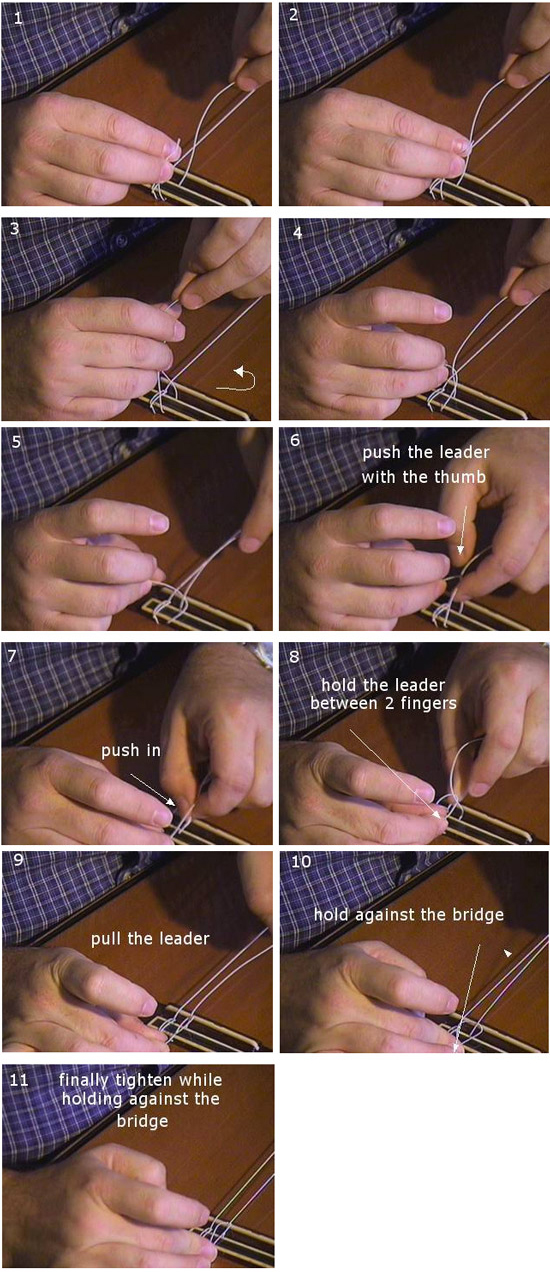
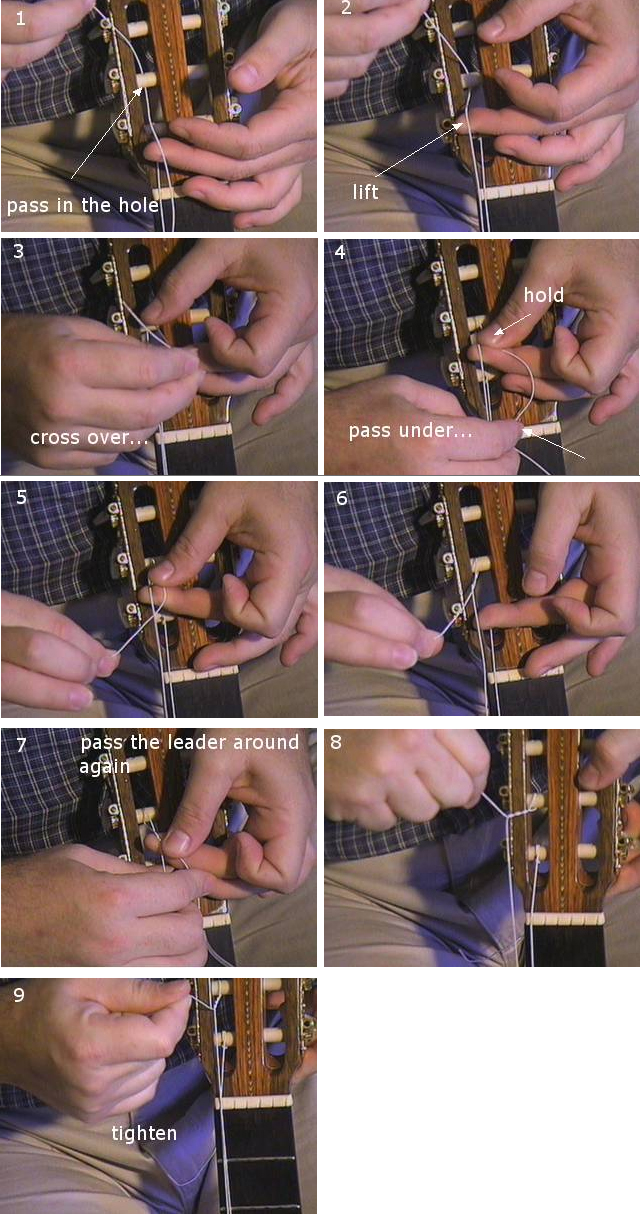
here to see how to put strings on a classical guitar
|