Back to Top

How to tune & String a classical guitar
The advent of tempered (tuned, with frets) instruments has brought a new light to stringed instruments tuning. The musician needs one note that he can use as the starting point of the tuning process. Typically, the source of the base note is a tuning pipe or the most traditional system of them all, the tuning fork.
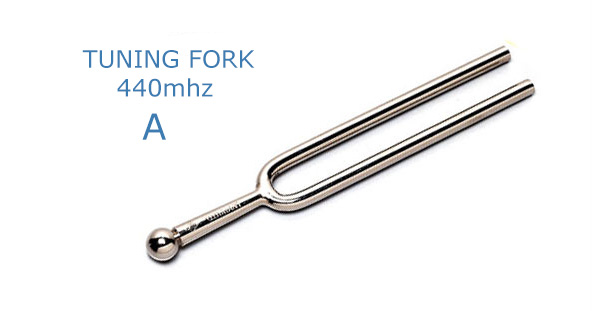
Orchestras tune using the first violin pitch as a reference. The first violin in turn uses the Tuning Fork (image below) as a starting tuning point. If an orchestra had to depend on each musician relative perception of tune -relative pitch- the result would be total disaster.
If the guitarist has a base or reference note to start with, he will be able to tune the remaining strings. After having gone through the tuning a number of times, the guitarist will notice that his brain has learned, to a certain degree, the sound of each guitar string. What is usually referred to as "perfect pitch" is not as much an innate talent but a learned skill. Just like most other skills it requires a certain degree of dedication and perseverance.
The key note is the high A which is found on string 1, fret 5. This note can also be found by simply lifting your telephone receiver. The pitch you hear on your landline phone is the A we are looking for. It is a world standard and will be the same A in the US or in Botswana.
But going back to the tuning fork, it is the least tetchy of all the tuning aids requiring no batteries etc. and it is practically speaking indestructible. What you do is hold it by one extreme, hit it on a hard surface and then keep the vibrating Tuning Fork in contact with the top of the guitar (the bridge area preferably) so you can hear the A resonate. You stop the 5th fret on string 1 and rotate the tuning knob one way or teh other until your ear tells you that the 2 pitches are equal. In other words, you tense string 1 or loosen it until the 2 sounds are equal (unison). I often help my students tune their guitars over the telephone (my novice students of course). They call me and I hear them play each string and tell them to lower or tighten it depending on how high or low the pitch is on each string. It takes 3-4 minutes to tune a classical guitar and it is a pleasure to be of help.
Video: How to Tune the First String Using the Tuning Fork
Once you are 100% sure that string 1 is tuned, you proceed to tune string 2.
The way you tune string 2 is by stopping fret 5 on string 2 (E) and tense or loosen the string until it sounds exactly like string 1 (E).
The way you tune string 3 is by stopping fret 4 on string 3 (B) and tense or loosen the string until it sounds exactly like string 2 (B).
The way you tune string 4 is by stopping fret 5 on string 4 (G) and tense or loosen the string until it sounds exactly like string 3 (G).
The way you tune string 5 is by stopping fret 5 on string 5 (D) and tense or loosen the string until it sounds exactly like string 4 (D).
The way you tune string 6 is by stopping fret 5 on string 6 (A) and tense or loosen the string until it sounds exactly like string 5 (A).
Video: How to Tune the Guitar Using the Adjacent String
Digital guitar tuners have become so cheap that anyone wishing to learn how to tune a guitar MUST get his hands on one. Tuners work in different ways. They either emit a sound that you have to match for each string or receive the sound of your string and tell you to increase or lower the pitch according to the sound they hear.
The table I prepared below is my help to you which resembles the function of hearing the sound of the given string and matching it by tightening or loosening the given string. I like the onboard systems that typically carry a 4-band equalizer and a digital tuner all in one. The Bellucci guitar I use in the video is fitted with one.
Press the Play Button For the String You Want to Tune
| E (Guitar String 1) |
| B (Guitar String 2) |
| G (Guitar String 3) |
| D (Guitar String 4) |
| A (Guitar String 5) |
| E (Guitar String 6) |
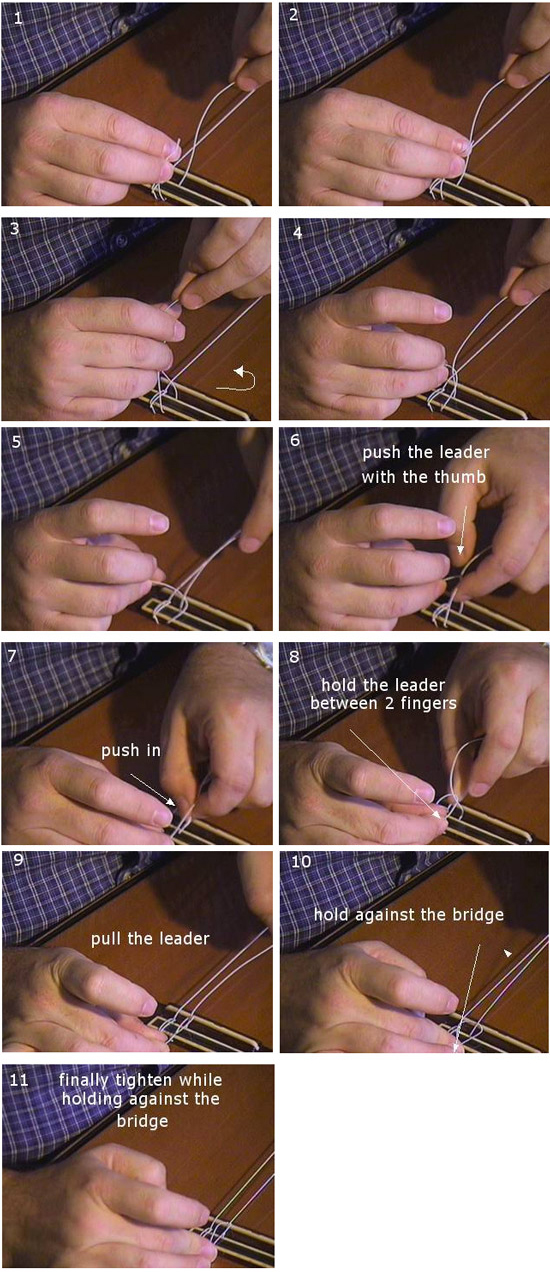
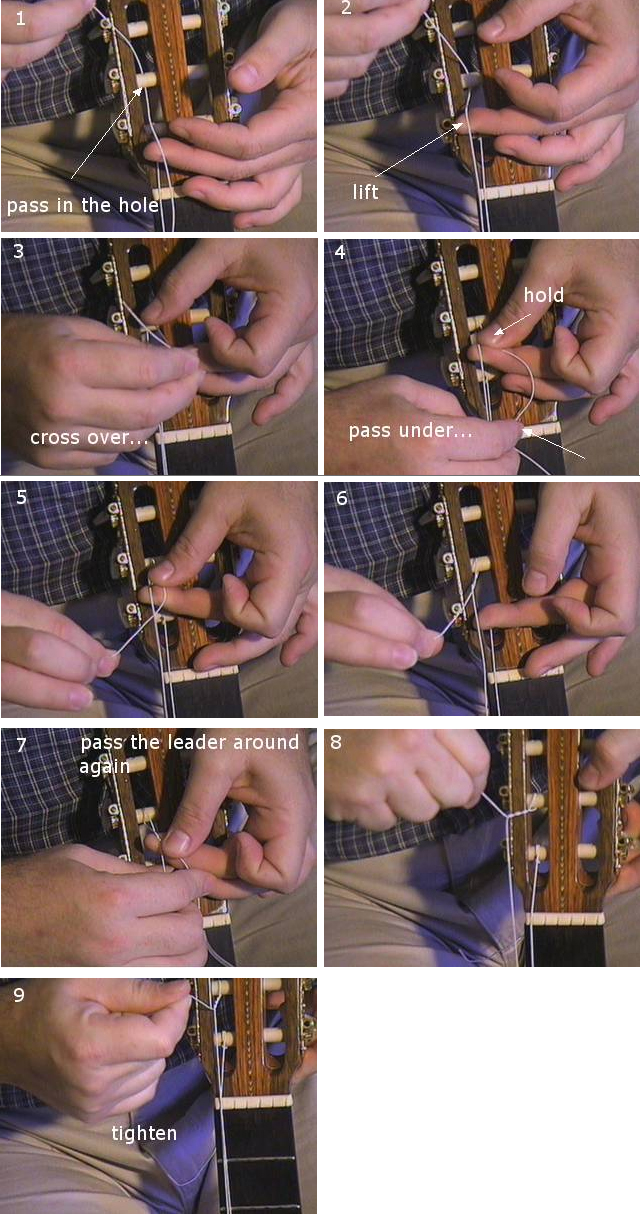
This is the most efficient way to string a classical guitar. I have only been perfecting this method with the years. I recommend you put a cloth or cling on plastic right above and below the bridge to prevent the strings to damage the finish during manipulation. If you do not use ball end strings, make a knot at the end of string 1. I can only start counting how many times this string snapped during the tensing phase damaging the lacquer.
1) Stringing the Bridge
2) Stringing the Head
The continuation of this class is in the members area, become a member today.