Back to Top

How to practice Classical Guitar
1: Introduction - Warming Up
Your guitar playing of the day will very much depend on the quality of your warm up session with the guitar. If you have made up your mind and are pursuing improvement with your playing, then you must have a little bit of that famous "athlete mentality". There is a lot of physical work involved in guitar playing and I am amazed to know hat many players do not even take a minute to warm up but get into their playing cold handed.
Musicians hurt their playing apparatus more frequently than you can imagine, RSI & Focal Dystonia can easily be kept at bay with simply incorporating a 10 minutes warm up session before your morning practice. As a matter of fact, warming up is an essential part of your practice and will define the quality of your daily practice and overall playing.
Start your warm up with movements that ease your hands and body into being with the guitar more intimately. It is also important to incorporate a warm up that prepares your body. If you plan to practice 2 hours, for example, you can warm your hands muscles playing scales (The Chromatic Scale is my favorite).
It is also a good idea to stretch your hands muscles before heading full force into the playing. Play for at least 3 minutes before attempting 5-notes speed burst. Warming up and stretching the muscles, tendons and ligaments regularly will prevent you from being prone to injury.
The middle section of the warm up is usually the most strenuous portion (6 minutes into the warm up). This is where you start feeling warmth building up in your hands. When your muscles are warmed and stretched, you will experience greater blood circulation and agility to help you perform at an optimal level. That is when you know you are ready for your daily guitar practice.
2: Practice for Life
I started playing guitar 45 years ago, the year was 1969. that same year Neil Armstrong set foot on the Moon and those of us who witnessed that life changing moment did not realize how widely and profoundly the shock wave of that achievement was going to impregnate every single activity where humans are involved. To be able to achieve the seemingly impossible suddenly became the new way of doing things. In the distant past, some outstanding fellow human beings attained the seemingly impossible by bringing about some astonishing deeds. In 1720 for instance, Johann Sebastian Bach composed The Chaconne (Learn the Chaconne in D minor with me here). But this was a more intimate type of achievement, not one that was going to be broadcast to the world. What makes the piece grand is the fact that Bach plunges in the depth of the human spirit and heart using his deep knowledge and closeness to God and music. Bach wrote the initials words Soli Deo Gloria or the initials S.D.G. on the score as a clear understanding of what had just been achieved as well as by and for whom. Below is how Bach signed all his work.
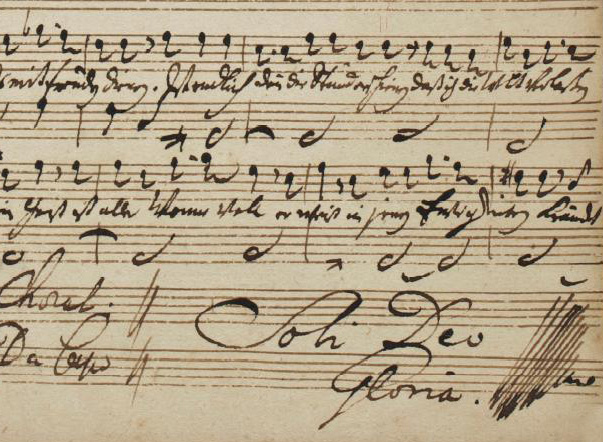
Although the prospect of being able to attain certain goals is undoubtedly a very powerful motivator, I discovered that the path that takes us to these goals is even more beautiful. Our lives will not be marked by what we achieve but by how we achieve it. This is how you can apply this mindset to the classical guitar and to your daily practice: The goal is the piece you decided to master and the path is the way you will master each single musical phrase.
This translates into descending to the very fundamentals of the task at hand. Fingering every measure using the best combination of fingers in order to preserve the flow of the music and ensuring that not a speck of energy is wasted in the process. Once you fingered a measure or a musical phrase, you look at the mechanics involved and what are the moves that your fingers, hands, arms and body for that matter will have to perform in order for the music to shine. Once you decided on a fingering/technical combination to approach the phrase, test it in slow motion keeping the playing apparatus under close scrutiny. At this stage you must assess if the playing feels natural, that means if you are using nature in your favor. Remember that such elements as gravity, inertia, force and flow are constantly embedded in your playing and you must be aware of each one of these factors and work with them to ensure the best possible musical outcome.
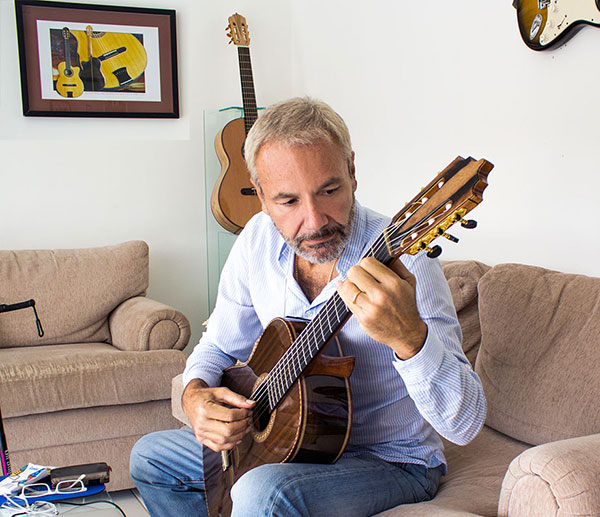
Practice in my Asunción Studio
Once the structural decisions have been made and the technical challenges have been detected, you must work each section relentlessly. Use the metronome for stretches of at least 3 minutes non stop. Start at a speed less than half the final speed. After every 3 minute practice run, increase the speed gradually and then repeat the work. After each metronome session, you will know if the fingering or technique need adjustments. If they do, apply the changes, practice a few runs with the metronome and then pass on to the next phrase. At the end of each 3 minutes session you will feel that your hands have become malleable and lubricated internally. You will feel a very pleasant mixture of pain and pleasure among the tendons, muscles and you will literally feel the energy flow through your veins and your nervous system. This is the proof that the work is efficient and this can only be achieved when your practice sessions are long.
Below is how I sign each one of my concert guitars. S.D.G. - Soli Deo Gloria inside all Bellucci Guitars.
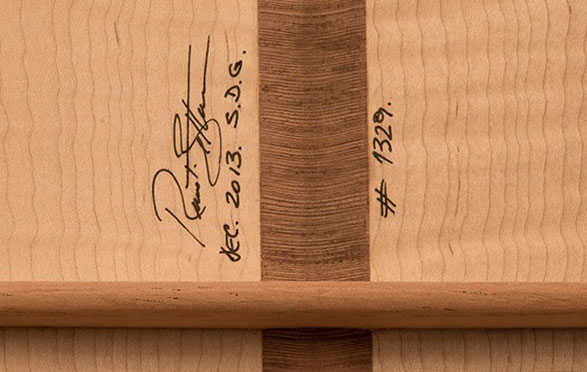
You should practice 10 3-minutes sessions with the metronome every day. The key here is to do this every day. You will see your hands achieve apparently unsurmountable challenges and you will be serving your life purpose.
The side benefits of doing this are the following: You will be growing in both human and supernatural virtues. Your daily practice is a sanctuary where you can become very intimate with your Creator. Daily practice is where musicians find God. The Cross will consist mainly in persevering and be very present and concentrated fully with the task at hand.
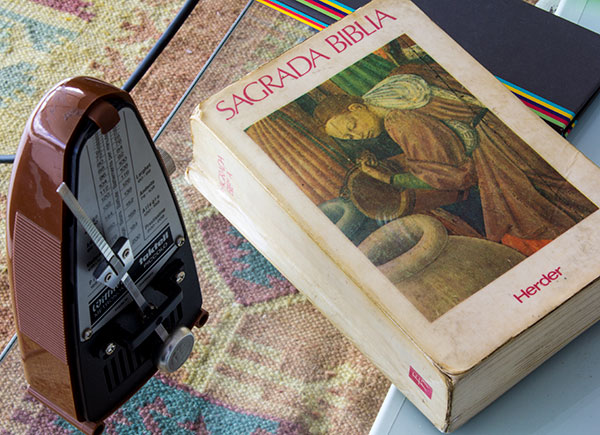
Above, my guitar practice essentials, a metronome and a Bible.
Keep the score at hand and write everything down clearly. Fingering and personal notes must be neatly written on the score because you must reinforce these improvements and personalizations before each practice session. This will eventually translate in our interpretation of the piece.
This is the complete picture of what it means to be a guitar player. The task at hand for a musician is to work with his heart and mind in God's presence. This is the only way that we can be totally immersed in the present moment seizing all the treasures that lay hidden in an hour of guitar practice. As a consequence, our playing will flourish and we'll come to realize that the outcome is really secondary because of the way in which we practiced. When performing the piece live, we'll be required to be totally present, concentrating on each note being played without letting our mind wonder around. You must stay focused, relaxed and think about nothing. Be absorbed by the notes you are performing at any precise moment and do not even indulge in thinking of the notes further down the line because these will detract power to the notes being performed in the present. This has to be an essential part of your daily practice. Practice presence and no thought if you want to be a world class performer.
The continuation of this class is in the members area, become a member today.