Back to Top

Classical Guitar Timeline
Classical Guitar Timeline
When compared to the violin, the guitar is a newborn baby. Carcassi's guitar is as similar to Segovia's as a Ping-Pong racket is to a tennis racket. Segovia's Hauser is as far from Contreras/Carlevaro as Nicky Lauda's Formula-1 is from Shumacher F-2003 GA. Therefore, we can say that the guitar and its playing technique are, practically speaking, still in their "embryo stage".
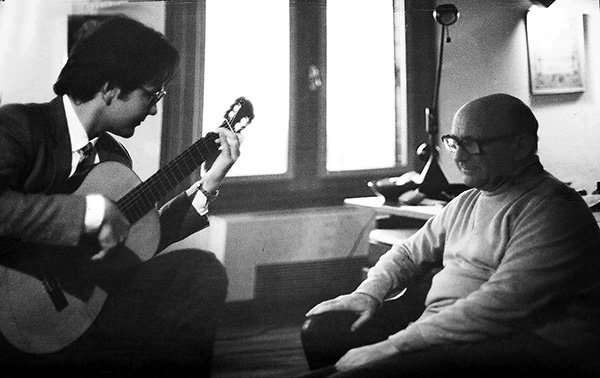
Renato Bellucci with Narciso Yepes, Las Rozas 1985
It is here that the figure of Abel Carlevaro acquires its enormousness. He was undoubtedly among the "greatest guitar teachers" who ever lived and left behind a legacy which will be the starting point for the classical guitar in the centuries to come. Using his great intellect and musical-aesthetical sensitivity, he took the time to write and teach about the guitar in terms which stimulate one's own ability to create. He used to say, referring to technique, "I'd rather think for 5 hours and practice 1 than vice versa". Every single technical difficulty was thought over and over and, from the brain, the answers would come and translate into movements on the fret board. One would be terribly disappointed to think that he had answers to technical problems or that he would get into technical jargon. He actually had questions and more questions to pose and, in the process, the answer simply stood out.
One of his greatest breakthroughs, besides having literally eliminated the rest stroke (Carlevaro realized that the appoggiato or rest stroke sound could be accomplished without changing the right hand posture), is having wiped out all the left hand noises and squeaks caused by the left hand fingers on the fret board; a phenomenon that most too often, guitarists forget how anti aesthetic and disturbing it is, especially to the audience. When other instrumentalists hear us, they usually wonder; how can we stand ourselves with all that "noise" that, for certain, is not part of the music, but all the contrary. The reason is simple: we simply ignore them and, our brain, learns to not hear them (selective hearing).
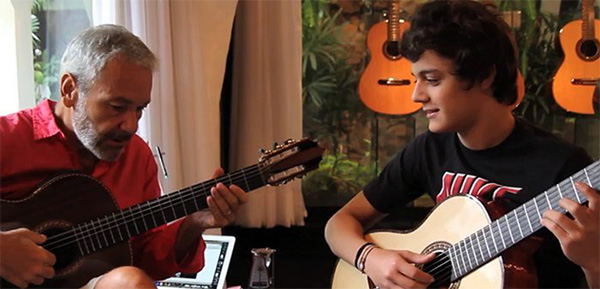
Renato Bellucci with his student Christian Roig
"How can I eliminate these noises?", I would ask Carlevaro... and he would reply: "First tell me, how do you produce those squeaks? Because you do them so nicely that I suppose you must have practiced them for hours!".
The worst part about not being able to eliminate left hand noises, was that I did not even know how I produced them in the first place, therefore, finding a way to eliminate them was actually 2 problems. He made me look into my left hand movements in SLOW MOTION and then would ask: "What would you have to do in order to eliminate that squeak?". I would again look at my left hand in slow motion... and before I knew it I had the answer(s) or at least some of them. He would then proceed to guide me through the rest. That was Carlevaro's teaching. Think, think and think again. The outcome was obvious: you would be making your own technique one musical passage after the other. Believe me, it is revolutionary! At the same time, it was always there.
Colleagues point to Carlevaro's Serie Didactica. I would recommend those 5 exercise books only if you studied with Carlevaro. Otherwise, you would be throwing money out the window (these books are useful only if Carlevaro's principles are applied). The book School of Guitar is worth every buck but I must admit that the English translation is awful and, though some insist that "keeping the Spanish syntax, was meant to "better transmit the real meaning", I know for certain that a much better job can be done. The Spanish edition of the book plus the images quality of the English edition make-up for the "ultimate guitar technique treaty".
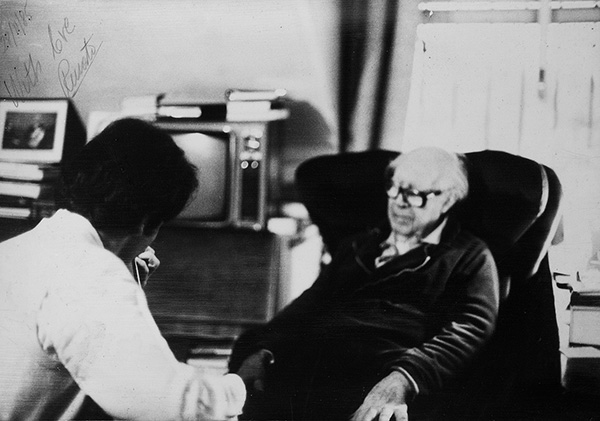
Renato Bellucci with Andres Segovia, Madrid, 1985
The US school of guitar missed on this great South American maestro. Bigotry as well as envy and bureaucracy have kept astounding performers like Yepes or Carlevaro from hitting the US scene more often. The Romero school was booming in the 80s in the US. The equivalent of my generation of players in the US is what I call the "plastic players" of America. You can barely tell one from the other. I say this, as an Italian citizen, who has lived in all but 2 Continents. It is difficult to understand and accept that Spain, and Europe in general, are no longer the Mecca for guitar. We better keep our eyes on South America and Asia.
I was astounded (one guy from Cleveland, who sat next to me, was actually muttering, while hearing the concert: "This guy sold his soul to the Devil") when I heard Eliot Fisk play the Paganini Capriccios in Akron, but destroyed Vila Lobos "Prelude 1" by playing it too fast. I define Fisk as a scales machine, "he covers all his musical and personality shortcomings by distracting the audience with stupid speed". I agree. Then again, who could render Bach more majestically than Narciso Yepes or be as consistent for over 40 years as John Williams and Christopher Parkening, or produce a sound as sweet as David Russell's.
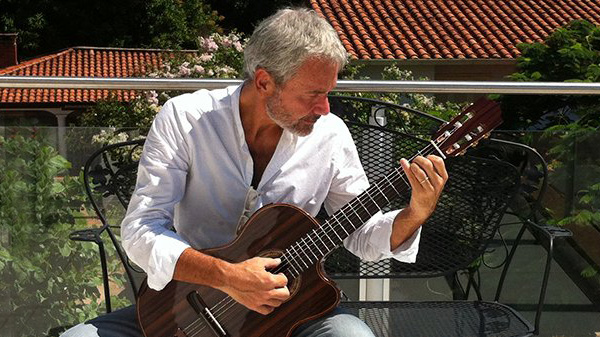
Renato Bellucci Playing in Asuncion, Paraguay, May 2014
I see them as a gifts from God to humanity. Artists who can literally drag the most colorful words of admiration from the deepest corners of our souls and break any and all rules. There are certainly many more performers who inspire these words. Some of them unknown by most of us, others, close friends or teachers or students.
Performers like these simply lift the standards and we all become better players. I center my site on learning the tools of the art of guitar playing and the truth is, that the right amount of performer teacher, makes for the perfect "maestro".
Leaving the few incredible talents out there who can do the unimaginable, mostly anything else can be acquired with the proper dedication and patience. Carlevaro was a master at both. I have committed my life to the teaching of master playing which is all that mangore.com is all about.
Europeans, South Americans and Asian players flocked Montevideo and literally followed Carlevaro from one masterclass to the next. Most certainly, many US players made the pilgrimage to Uruguay in the 80 and 90 to study with Carlevaro in person and the reason was a very simple one: when you studied with him, you discovered yourself, the only one who would play great for you. I recommend you do the same: Think, think, think.
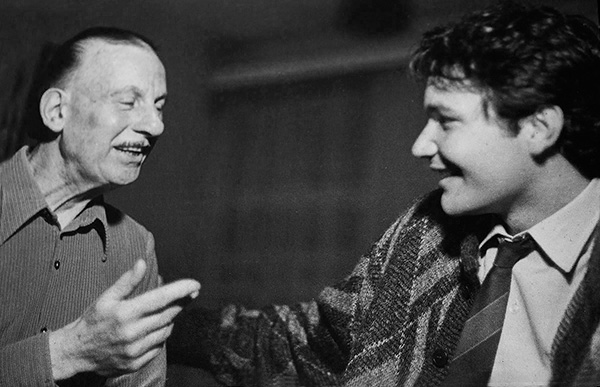
Renato Bellucci with Abel Carlevaro, Montevideo 1986
With the right amount of faith in your teacher and in yourself, it is no time to think, "it is too late to try a new approach. I have invested 20 years in playing the way I do... such and such famous player does it... I'll stick to what I have". If for any reason, the following equation applies to you, you better rethink your whole approach to guitar playing because you can only fool yourself for so long and frustration passes a high bill on a guitar player soul:
The Equation: You practice constantly + you love what you do but you never feel secure when you play = you ought to change the way you play.
If the rule sounds too simple to be applied to a "many years" patient effort, I understand. We are all humans and tend to stick to what we know and fear the uncertain or unknown... nevertheless, we stick to a technique which, more than a technique, is a lottery!
You must have total control over your technique, and no matter what brand name your technique has, if it does not work for you, it is useless! You were designed, "from before you were born", (Segovia in the 50s) to play in a certain way. My technique does not have a brand name. It is the result of mixing several techniques throughout the years, just like a recipe, plus, finally, adding the one ingredient that had been always missing: my very own.
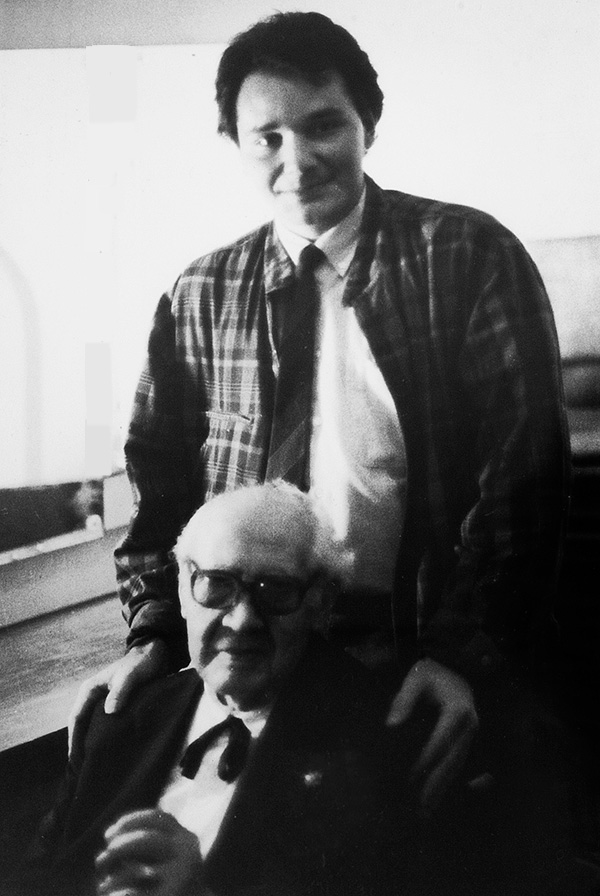
Renato Bellucci with Andres Segovia, USC LA, 1986
As the ingredients were being added, my playing got better, but frustration was, eventually, always around the corner. I will enumerate the ingredients:
- Segovia technique -both hands- 1969-1984 -high level of frustration-
- Carlevaro technique -both hands- 1984-1987 -low level of frustration-
- Jose Tomas technique -right hand, Carlevaro- left hand 1987-1996 -started to see the light-
All of the above + my technique from 1997 to the present day - YES! I had to tell the world.
My technique translates into your technique. That, in turn, means the way you will have to play and that takes thinking and freeing yourself of all the "bonds" to great names and discover that yours is a great name!
I recently received this mail by a student of mine who decided to give the recipe a try:
"But with your method your wrist and specially the fingers are now positioned in almost PARALLEL to the strings so doesn't matter whatever deviation you have in your finger angular movement you always fall at the right string... this way the natural space between the fingers coincide with the natural space of the strings. AAAAAAMAZING! Thank you thank you very much Renato".
How can I help you being separated by probably thousands of miles and not knowing each other personally? I designed this web site to teach classical guitar to players all over the globe.
To classify guitar players is certainly not a pretty job. Though, comparisons are not, as many say, "hateful". Only by comparing can we add er (as in cheap-er) to nouns and adjectives. As I was meeting guitar players over the years, each one of them took a place in my heart and marked my life and career one way or another. I do not believe people when they say "One thing is the man and a different one is the artist". The only ones who can really say that, are those who only know the artist. Once you meet the person, you will never be able to speak in those terms again with a sincere heart. I use this as an introduction to the one player that keeps motivating me 5 years after his death, 20 years after we first met in person and 26 years after I first heard his playing.
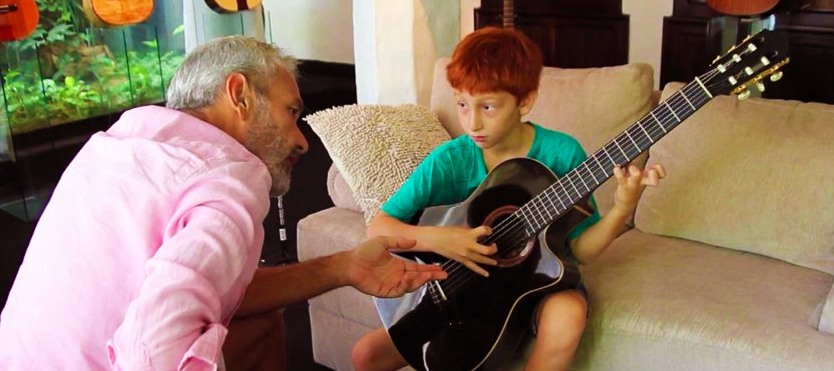
Renato Bellucci with his son Matias Bellucci in Class, February 2014
Narciso Yepes broke all my preconceived ideas about artistry and the life of an artist. He was, in many ways, the first musician that showed me that it was possible to have a life full of the most normal thing while aiming at creating the purest form of artistry. Here was a man who had a beautiful home near Madrid, a lovely wife, children. He had his share of the Cross to carry, (Yepes' son Juan de la Cruz died in 1986 at age 18) yes, he also taught me how to carry the Cross with grace. That is the one thing we all have... for sure... we only differ in the way we see It and carry It. He always had a smile for me and his eyes were filled with joy every time he talked about la guitarra.
This was the man who made epic guitar recordings for Deutsche Grammophon... the man who put the Aranjuez Concerto and Rodrigo on the music map. Or who do you think was the guitarist who first played and recorded Romance? The guitar was the most noble instrument in his hands. His choice of repertoire FANTASTIC. Medieval, Renaissance and Baroque took an immense dimension in his playing. His Recuerdos de la Alhambra is the only real Recuerdos de la Alhambra in existence. His 10 strings Ramirez sounded like the perfect guitar. I still remember vividly the grandeur emanating from his instrument the time I had the chance to play it. The resonances created by the 4 extra strings created gran-playing.
Kazuhito Yamashita - Amazing Phenomenon
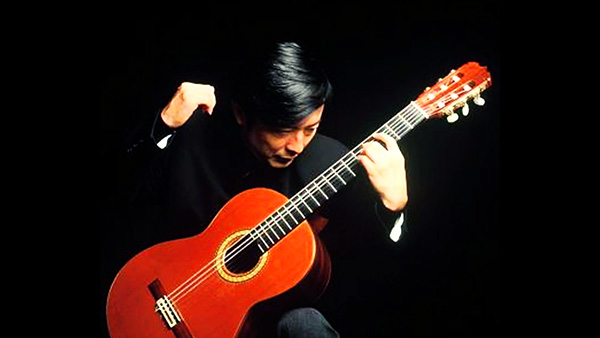
Guitarist Kazuhito Yamashita, deserves a special paragraph. His playing of Mussorgsky's Pictures at an Exhibition is devastating. He premiered the work at the 1984 Toronto festival/competition and changed the classical guitar scene forever. Players attending the festival could not believe what they were seeing and hearing. They were realizing for the first time that there are talented and SUPER-talented players. Yamashita is a loner in the super-talented category. No other player will EVER play the work so well and make a similar impact. I mean he literally invented a series of techniques to be able to play the work... total independence of the fingers in order to achieve special effects and amazing feats like tremolo using the little finger or the index finger alone just to mention one or a Stanley Jordan approach to both hands plucking.
If the classical guitar was ever played like a "miniature orchestra", that was the time.
Yamashita can never be boring... some of his squeaking can hurt some compositions and his need to show off often gets in the way... No matter what we say or do, we have to come to terms with the reality that only certain players can play certain pieces.
After Yamashita's performance in Toronto, the festival slowly and steadily came to an end. There are not enough Yamashita's around to keep the interest alive. Many US players boycotted Yamashita's return to the US concert scene because they feared that their careers would come to an end if the young Japanese player kept humiliating them... He eventually returned to America on several occasions but the simple fact that his name does not pop-up automatically as one of the all-time best players gives strenght to my words.
Kazuhito Yamashita is without a doubt one of the greatest guitar players and musicians of all times. Born in 1961 he belongs to a generation that saw when Neil Armstrong set foot of the moon in 1969. He already was an accomplished player when he saw the televised Apollo events. This generation of players carried the belief that anything is possible and when the '80s came along they were ready to show it. Kazuhito went on to win every guitar competition in the world and in the mid 80s achieved his very personal "lunar landing". He transcribed Mussorgsky's Pictures at an exhibition for classical guitar and premiered the work in Toronto. Below is an excerpt from that landmark performance. This performance changed the guitar scene forever! The video quality is poor but what you see and hear is unbelievable... he was only 24 years old. Hear and look carefully because this is perhaps the only time you will see the guitar reach such amazing heights.
Pianist Barry Douglas had just won the Tchaikovsky piano competition playing the same piece and was the first Briton to win the competition ever. Therefore "Pictures at an exhibition" was the piece of the time. What nobody could believe was that such a minute instrument as the guitar could make it shine; and shine it did. Yamashita invented innumerable techniques in order to play the piece being one of the most striking a tremolo played using the little finger only (ch) which is a finger that is not normally used in guitar playing. He needed the other fingers to carry on simultaneous chords. I will examine the complete work in the future. S.D.G.
The continuation of this class is in the members area, become a member today.