Back to Top

Learn how to read music notation
HARMONY
Whenever 2 or more sounds are played simultaneously, we are dealing with harmony and the concepts that govern it. More mature musicians, listeners and the natural talents, see notes and pitches as colors. It is easy for someone who deals with colors to distinguish between different shades of the same color.

Green and shades of green.
The world around us, has taught us how to see and distinguish between different shades of a given color very easily. Almost anyone of us can tell that the line above is: green with different shades of the color. We could easily describe and even reproduce any of these colors.
With the ear, something very similar happens. There is a musical sound and all its shadings. These shadings are musically called triads which are made by intervals. Triads in turn make progressions. Western music is based on this acoustic architecture.
Interval is the distance between two sounds... distance in music means the amount of aural tension created by two notes.
Let us examine the different elements separately so as to be able to understand the whole better.
A musical sound: Think of the sound of A on the guitar. The same sound on the flute, clarinet or oboe is still called A but it has a different tone quality. This is a phenomenon that exists due to the fact that no instrument, except the electronic synthesizer, can produce a perfectly pure sound. All instruments and voices produce a rich spectrum of partial pitches.
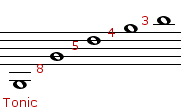
When the violin plays the low G in the above staff, the following 4 sounds can be heard by the trained ear (actually, more than 4), These are the accompanying pitches that make the sound of the violin so unique. The rules of acoustics that govern the production of this phenomenon are immensely interesting but beyond the scope of this article. What is interesting to notice is that: 1-if we take G and call it point 0 and include it in the counting to the next G we have an octave (8), 2-if we count from G to D we have a fifth (G A B C D) 3-if we count from G to B we have a third (G A B). These distances or intervals are the backbone in the making of harmony and music as we know it.
The staring point (Tonic) the third degree mediant, and the fifth degree dominant. Out of the 3, the Tonic and the dominant (The first and fifth degree of the scale) are the most important ones.
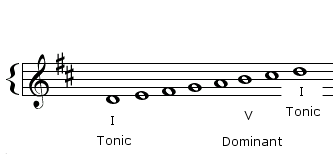
If we play above the tonic and the dominant at intervals of a third and fifth, we have major triads. All major (and minor) triads are made of a perfect fifth, a major third and a minor third.
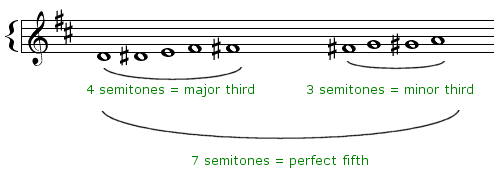
 Hear a Major third |
Hear a Minor third |
Hear a perfect fifth |
This association of tensions between the 3 notes in a major triad is very pleasing to the ear. The listener is usually moved towards these emotions: Purity, order, devotion and worship. Therefore, just like a painter with colors, when the composer wants to transmit any of these emotions, he will use the major triad.
Just so as not to lose sight of what we are talking about, all of the above terminology translates into: "shades of colors".
The terminology in harmony is quite unique and, although at first it may sound confusing or complicated, it is not.

The tonic: The tonic commits the whole piece. It is like a gravitational force over all the other notes in the piece. It is the absolute point of rest and resolution of the tonality.
The tonic is, essentially, the note that gives the name to a given tonality. The concept of tonality will be clearly understandable as you read on these pages. Tonalities are perfect beings, where every acoustic force has meaning and tends to find fulfillment in the tonic. To give you a graphic example, if you play a piece in the tonality of D major, your ear will not feel at ease until the D major chord is played. The piece will consist in taking the color D and dilute it over and over. Eventually, you go back to it. Every time the progressions move away from the tonic, aural tension is created and different amounts of pleasure will be attained depending on the composer's skill in returning to the tonic... or avoiding it temporarily.
99% of the pieces of music you play and hear, begin and end with the major or minor triad or tonic of the tonality you are playing in.
Example:
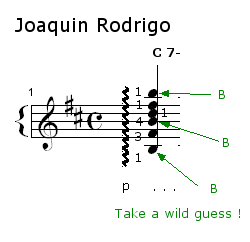
In the above example, you do not have to be Beethoven to figure out the tonality. You can say, with almost total certainty, that it has "something to do" with B. The legitimate question following is: is it B major or B minor? The answer is in the key signature. I know, you know nothing about key signatures... no problem.
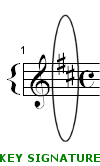
I would also like to introduce you to the Music Keys and you will notice -by looking at the image below-, that music keys are divided between Major and Minor. Every Major Key has a Minor relative key to complement it. Why all these names and all the Major/Mimor relatives? As I mention in the Harmony Section, each key is to a musicain the equivalnt of a color palette to a painter. If the composer wants to use say Brown and all its relative colors he will use a music key instead of another. When it comes to emotions, the choice between Major and Minor will be essential. Many pieces are divided in 2 parts... one part is in the Major ey and the other is in it relative Complementary Minor Key or viceversa.
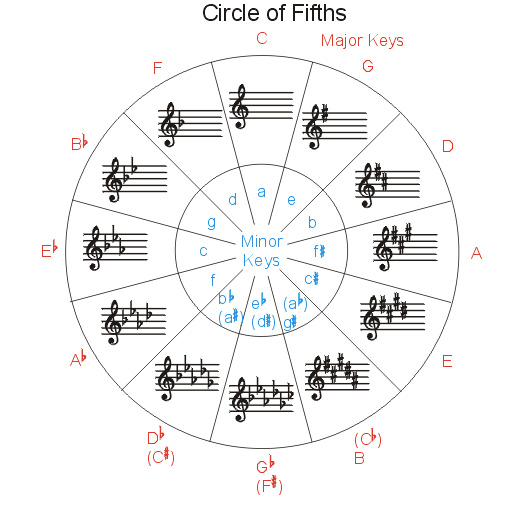
Above I depict what each key signature and its relative Minor equivalent look like. The Key signature is always written at the very beginning of the staff riht next to the G cleff. I will teach you the trick(s) to figure out every key signature without having to memorize them all. Still, you do not really need to learn them all by memory because you will discover that most guitar music only uses a handful of key signatures on a regular basis whilst many others are almost completely neglected. Mostly, this is due to the nature of the guitar that blossoms with some tonalities (E, Eb, G, FMinor, A, AMinor, D) and nor so much with others (Db, Gb...)
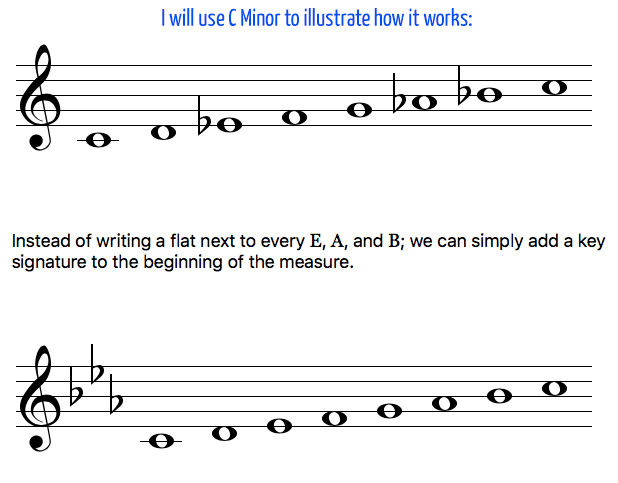
The continuation of this class is in the members area, become a member today.