| Antonio
de Torres Jurado, the 19th-century Spanish carpenter, is the man often
associated with the classical guitar modern form. Legend has it that he
was inspired by the figure of a young lady in Seville Spain. Not precisely
a scientific approach to guitar building. Torres' guitars
were the first large guitar especially compared to the ones seen until
his time. Larger guitar body translated into larger sound. His guitar design
has been the model for guitar builders for most of the past 100 years.
The guitar
is made by a living material, wood, and just like any living material,
no two guitars are alike. The Australian physicist Joe Wolfe : "Wood is
not a predictable material." (I guess you do not have to be a physicist
to figure that out!). This is in part responsible for the often heard relation
between the guitar unpredictability and woman's unpredictability... I personally
think that men and women can be equally predictable or unpredictable according
to how you want to see it.
Read about rosewood
The motion
of the strings acts like a pendulum and each string creates a very complex
and unique pattern. Then, to add more complexity, each note creates its
own very unique pattern within the pattern. Whenever an E, F or G are played
on the 6th string, the guitar inflates like a balloon. The top and back
of the guitar move closer and away from each other in terms of microns
per second. The higher the notes and the strings we pluck, different parts
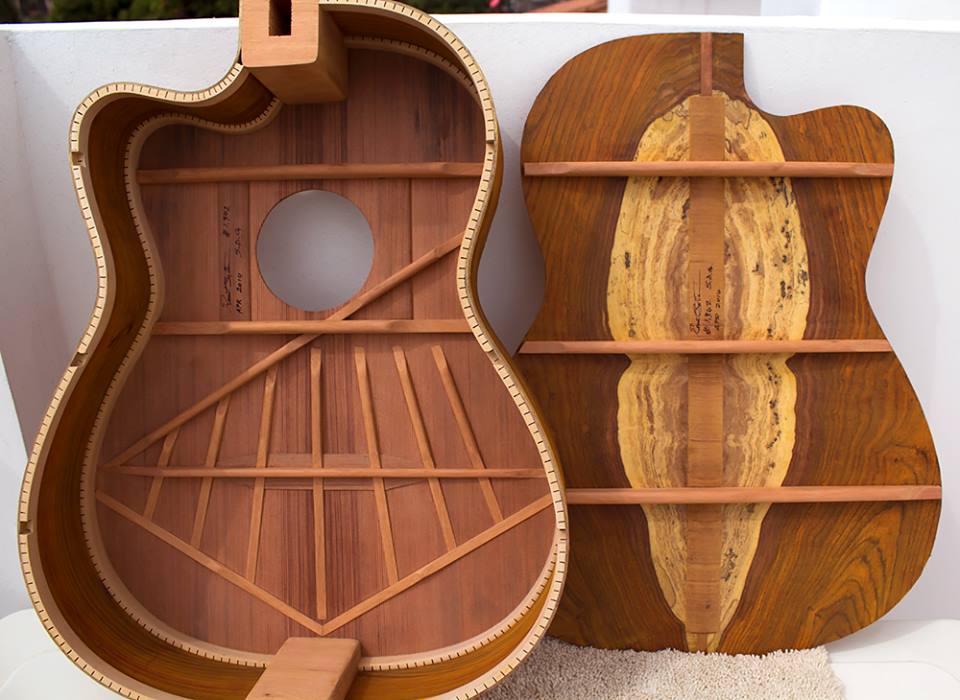
of the sound board and back vibrate. The braces underneath the sound
board, divide it so as to allow for different parts of the board to vibrate
according to the string plucked.
Basics of guitar making
Allow a few seconds for the animation
to load...
The above image, although hyper simplified,
shows a very straight forward fact: The guitar is a simple instruments
to build. A few parts of construction like shaping of the neck and head,
thinning of the top and routing for bindings require talent, practice and
concentration. Still, anyone pretending that he is a rocket scientist for
building a guitar, is lying.

Every luthier has a plan with all
the measure of every single piece of wood. Plans can be bought and it is
just a matter of deciding which model to build. What you will find out
eventually is that they are all, practically speaking, identical. They
are all based on the Torres model. Some have an extra strut, or a strut
less. Still, others make the struts longer or shorter... no matter what
they do, the variation is unperceivable to the human ear. Just remember
that a Stradivarius can barely be told apart from other violins even by
experts, let alone a 2000 dollars guitar.
Guitar builders need the basic tools
of a carpenter. All the parts, except for the neck, are straight, so, no
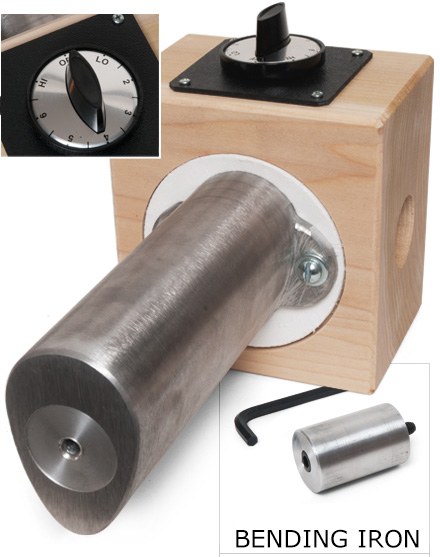
special sculpting tool or skill is needed either. Bending the wood is as
easy as heat and pushing. Below is a bending iron....
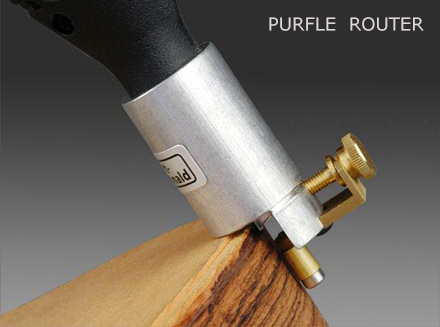
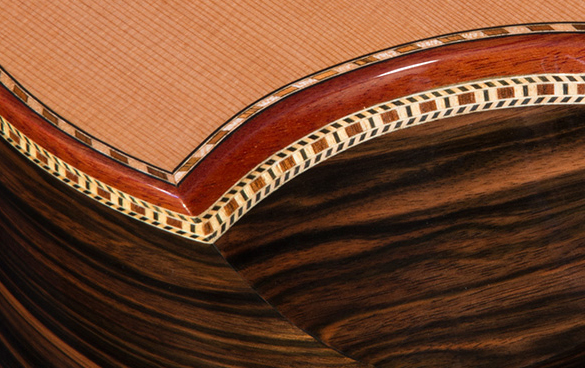
Purflings, bindings etc. are bought
pre-made and by the meter. A simple tool like the one below makes the way
and the binding is glued in.

Rosettes and tuning machines are also
bought by the dozen and simply glued and screwed in... With the years,
builders experiment here and there and some results are worth repeating.
Other times, the experiments are simply to be discarded.
Good quality
woods make for first class instruments because selected woods allow
for thinner filing. The thinner the top, the more it inflates when the
string is plucked producing the best, most powerful sound. The higher the
grade of the top, the more it can be filed (reduced). That is why you must
only make sure that your guitar will use the best possible woods. Better
woods will make better guitars. It is better to play on good quality
Mahogany than to play on low quality Brazilian rose. A lot of Brazilian
rose around is low quality. The father of the modern guitar, earlier
mentioned Torres Jurado, proved that the real important part of a guitar
is the top and not the back and sides. He built a spruce top with mache
paper for back and sides. The guitar proved to be a terrific instrument.
The top of the guitar is the most
important part of the instrument. Spending a fortune on back and sides
is foolish. Choose according to your aesthetical taste.
Special artist builders are called
in when it comes to some astonishing inlay work on the instruments and
these are nowhere to be found. Look at the work on Barrios' 1883 Marin
guitar. That is the type of work that only a few extremely talented men
can do... a true piece of art.
I stress these facts because I think
that builders have gone mad asking for astronomical amounts of money for
a few pieces of wood, bindings and shellac. It can take as little as 10
days work (hard) to build the best of the best guitars...
The sound
board is the most important source of sound on a guitar. Spruce,
redwood cedar and pine (Canadian, Spanish, Italian) are the favorite top
selections for this key part of the guitar. Builders look for trees that
have grown slowly, usually found on cold mountains. The reason is that
the density of the wood and the wood fibers will be higher. Pines are usually
the trees that grow at higher elevations. The builder can tell about the
density of the wood by hitting it gently with his knuckles. Specialized
wood sellers do the selection for you.
Luthiers can
only make a few dozens guitars each year and this allows for little scientific
experimenting. This will always make luthery remain more of a craft than
a science.
.
Few guitarists
need to spend more than 1,000 $ to play at their best and,
playing well, is seldom associated with the price tag on the instrument.
I often play on my old 100 bucks instruments. (I keep my old instruments).
The ones built in the 70s (mine), focused on playability (good approach)
Sound was poor at best but that was why you dreamed of owning a concert
babe.... After the 80s, with the advent of Yamahas and Takamines and all
sorts of factory guitars, a whole new breed of laminated instruments invaded
the market. These impress the ear but are impossible to play and induce
the player into acquiring every possible left hand technique defect available.
If you are a beginner today, you MUST buy a cheap concert guitar
so you will play THE RIGHT WAY from the beginning. Avoid being one
of the millions who fall in the 400 bucks Japanese guitar trap only
to end up frustrated for not going anywhere with your sound and playing.
The cheaper the guitar, the harder it is to play (to achieve a given musical/technical
result)
Guitars in the 7,000-15,000+ US$ price range are rip-off instruments.
The incredibly high cost of living in the US, Europe and Japan partially
explains some
insane prices...The truth really lies in the fact
that since most luthiers only build a few instruments a month, they have
to "make all their living" selling 2-3 instruments a month. Free
markets can easily become circus market. As a rule of thumb, remember that
if a luthier were to buy the
rarest woods and the most expensive
tuners and accessories, he would not spend over 1,200 US$. Naturally, astronomical
figures can also be spent on some ridiculous accessories as the tuners.
Some brands cost well above 1,000 US$. A 300 $ tuner will last 2 lifetimes,
spending more than that is also crazy. Changing 40 bucks tuners every few
years is, in my opinion, the best option. The real case scenario is that
materials add up to approximately 400-600 US$. There is no reason why some
guitars can cost so much. It doesn't matter what the seller says. A few
extra bindings and some exotic woods can only add up a few hundred dollars....
The key element is a talented builder, one who has a natural intuition
with wood and can create a musical instrument.
FACT:
The more you spend on a guitar, the better you will be expected to play
LOL!
Wood selection
is perhaps the most important part of the building process. It is known
today that the wood used by Stradivarius for his violins built in the 1700-1720
span of time were built using woods that grew in what scientists call a
micro
ice age that hit Europe from the mid-1400s until the mid-1800s...making
trees grow much slower than normal. "Grissino-Mayer at Tennessee and Dr.
Lloyd Burckle at Columbia suggest a "Little Ice Age" that gripped Europe
from the mid-1400s until the mid-1800s slowed tree growth and yielded uncommonly
dense Alpine spruce for Antonio Stradivari and other famous 17th century
Italian violin makers". It is essential that you trust your builder and
those that provide him with wood.
The
above chapters have sent a wave through the bones of many builders and
guitar dealers the world over. I have been the target of all types of defamatory
comments in different online media. My students deserve to know the truth
and I sincerely could not care less. Hundreds of players enjoy my instruments
and saved themselves from spending astronomical sums of money for NOTHING
! The facts speak for themselves.
Becoming obsessed
with the looks of a particular cut will most likely make you overlook more
important factors like exceptional density, grain flow and mineral streak.
(This formula
only applies to new instruments... antique or collection instruments are
valued differently). Antique guitars sound sloppy. They were not
built like Stradivarius violins...they were the first attempts by amateur
builders... so, if you buy them, prepare yourself for the disappointment
of your life. Some nuts out there offer these for over 20 or 30 thousand
US$...simply crazy...and some people are even crazier to buy them !! I
only cherish instruments that were played by great guitarists because they
were a part of the artist and instruments that were highly decorated because
those are true masterpieces. Unrepeatable. Check Barrios Mangoré
guitar from the 1800 Surviving
Barrios Mangoré guitar
Agustin Barrios' guitar
The lure that
traps
many guitarists to buy these expensive instruments is that the player thinks
that playing on the expensive guitars is easier.
FALSE !
Spanish instruments in particular are difficult action instruments.
The Spanish luthier school grew around Segovia and I am sure you have seen
Segovia's hands...huge and fat...this translated in muscular mass which
made it easy for him to play these instruments. This is not the case with
most players. Especially the non professional players.
You do not
buy an F1 Ferrari to go around the streets of your town but a production
Testarossa.
Today,
guitarists have many choices of splendid instruments available. I
will share with you what I would do if I wanted to buy a guitar
today. There are a few things you have to keep in mind: Where will
I play my guitar most of the time? Will it be a concert hall, a club, a
recording studio? Will I use a microphone and a PA? (In the black and
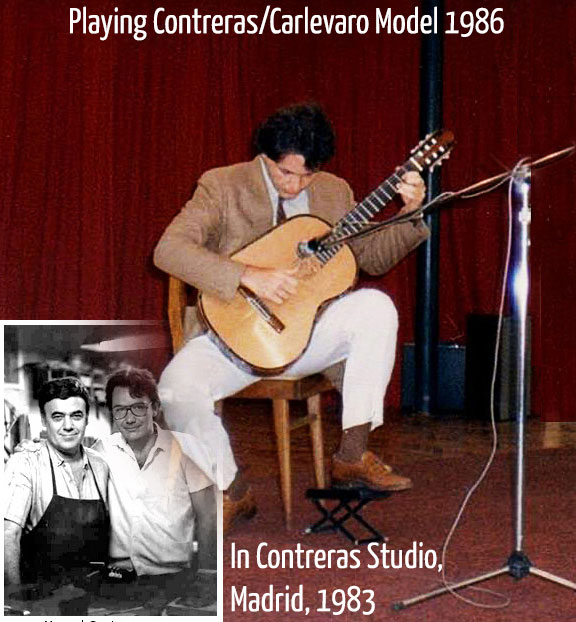
white picture, Segovia is looking at my guitar in his studio)
In the 80s
(the decade of extremes), guitar constructors and players were trying
to create instruments to play as loud as possible and show the world that
the guitar was a "real classical" instrument (as if "classical" and "loud"
were synonyms). Some of these instruments were literally wild beasts that
had to be "tamed" more than played. With all that, I have attended concerts
where these instruments were played and you could barely hear them if a
mosquito flew passed too near and you did not have the cash to sit in the
first 10 rows. So, eventually, with the advances in electronics etc., you
would see the concert players using microphones and pickups to amplify
their instruments. Luthiers, on the other hand, realized that they
were putting the hard work and the money in the wrong place. The worst
part about it is that for every decibel in volume projected, you had to
invest 3 or 4 thousand dollars and you could only increase the volume "so
much". Sound quality depends on the plucking technique used and,
the rest, is suggestion or illusion. For the past 2 decades or so,
guitar constructors have been focusing more on making the playing experience
more pleasurable and solving the real problems associated with guitar performance,
is slowly becoming the main goal.
.
What are the
features you should be looking for in a guitar? I think that the best way
to go about it is the following:
-Do not ask
too much information about brand, wood, etc. The heavier the instrument,
the better. It will stay in place better and you will be able to build
a solid technique around it. In any case, when you order a concert guitar,
specify if you like heavy or light construction.
-Buy new musical
instruments.
-With Spanish
guitars watch out for the following TRAP: Spain is one of the driest countries
in Europe, especially Madrid. If the place where you live is not as dry,
allow for some time of adaptation for the wood. More dangerous than the
dry-moist
guitar trips are the moist-dry ones. The wood will tend to lose
humidity faster than the wood allows and you can see cracks appearing all
over the varnish, wood and even the fret board (the frets will stick out
either at the top or bottom (or even both) of the fret board. The immediate
thing to do in this case, besides crying, is to put your guitar in a bathroom
and leave the hot water on for a few hours.
-If you are
new at the guitar, then it is likely that you are not sure of what to look
for and how a guitar should feel in your hands. If that is the case, allow
the builder or your teacher(s) to help you choose wisely.
-If money is
a deciding factor, wait. It will not be long before you can afford a more
"unique" guitar.
-Keep an open
mind when it comes to choosing your guitar. I have witnessed the
following anecdote in 1986:
John
Williams (the guitarist) was about to give a concert for BBC in downtown
London. It was a noon concert with live FM broadcast. Williams was going
to play his Fleta. An "unknown" luthier approached him with a guitar
in his hand and said in an Australian accent:
-"Maestro
Williams, I build guitars. I would like you to try mine".
Williams reached
out to grab the guitar and, while standing, played a couple of fast arpeggios
on the guitar and said...
-"Good.
I will play it right now!"
Williams got
on stage and played the concert with the Smallman guitar. He still plays
Smallman to this day.
I have since
heard and seen Williams play with this guitar in all kinds of halls, all
kinds of repertoire both amplified and non-amplified. What it teaches is
that from a player's point of view, all that really matters is how the
guitar sounds and if it captures your imagination... the rest is nonsense
I say this
because since I decided to sell the Paraguayan guitars on my website, I
receive the most incredible questions by some novice players which show
that, very likely, they will end up playing the guitar everybody else says
is the right one. |