Back to Top

Carlevaro Technique
Maestro Renato Bellucci
Many guitar players are often wasting a lot of precious energy trying to compensate for the anatomical wrong sitting positions with the guitar. When examining some of these players, the Uruguayan Maestro Abel Carlevaro used to say: -"They would play much better and for longer with better, more natural postures". Carlevaro was referring to players of the stature of John Williams, Christopher Parkening etc.
I would not dare to go that far, but Carlevaro talked from the vintage point of one of the few who had taken the time to study the physics and anatomy involved in guitar playing. Carlevaro's technique is among the few that has gone that far and he passed his knowledge to his students. I studied under Maestro Abel Carlevaro in Montevideo, Uruguay from 1985 to 1988. Let it be clear though that you if you think that Carlevaro Technique is a way of playing whereas by following a number of steps you will eventually end up playing and sounding like Abel Carlevaro you are heading for a big disappointment. Following a series of concepts and a method of study, you will eventually discover your guitar technique, the only guitar technique that will ever work right for you.
MAESTRO ANDRES SEGOVIA
Segovia played well into his nineties, but it is true that the amount of strings squeaking was unbearable as his age increased and his energy died out. The amount of strength needed to play with little left hand noise twisting the torso and an anchoring the left elbow against the waist is enormous. In some of Parkening recordings for instance you can actually hear the moans of pain here and there. Today's guitar technique standards require more perfection and the so called "recording strings" should be called handicapped performer strings. A good set of worn-out strings is better. Trying to play like the "dinosaurs", is prone to make us frustrated .
Talent can make up for a lot of defects, but I have known quite a few guitarists who had to abandon their careers due to serious injuries that originated in a faulty sitting position. The article you are reading was written in 1997 and earlier this year (2014), the legendary American guitarist Christopher Parkening had to retire from playing due to serious lower back problems. And all for what? Surely not worth the price!
For most of the XX century, the guitar was to be played like Segovia did. Nobody asked too much back then, because a word of admiration from the Andalusian Maestro opened many doors, a word of dislike had the power of ending or seriously jeopardizing a whole musical career. But the dictatorship years are finally over.
Be brave and always ask your teacher "why?". "You will understand later" is a bad answer.
It is true that Segovia contributed enormously to the growth of the guitar repertoire and took it to high levels of admiration, but it is also true that guitar technique got stalled for decades because of his stubbornness. He would bring hell on Earth if you changed the fingering to his "precious transcriptions". Look at the video below if you do not believe me. I witnessed that 1986 USC Masterclass first hand.
Players like Yepes, Barrios or Carlevaro who tried to introduce new ideas both in instrument design and technique, were dismissed a priori.
Perfection being the ultimate, unattainable goal, makes it understandable that concessions have to be made. But a whole generation of players was stuck on the same variation: To play with the outer part of the nails and twist the body around the guitar like a snake. -Some of these players have changed somewhat throughout the years. They sold us the illusion and lie that speed was all that mattered and have burned this idea in every guitar player of my generation and the contemporary guitar scene has inherited this monstrosity.
When their years were coming to an end, players like Segovia would start sounding wise and philosophical: "You are the general of your fingers and not vice versa" -Andres Segovia to Marcelo Kayath in his last masterclass at USC, LA 1986-. Competitions are the Cathedrals to this horror and you will always find one dinosaur or two behind the organization. There are a zillion better ways to build a career, therefore, take my advice and avoid competitions, plus, a competition won, guarantees nothing. The few bucks evaporate fast and the concert tour is over even before it starts. It is believed that at least 1,000 "major guitar competitions" winners are still out there. How many do you know? How many visited your hometown? How many are still playing?...
I do not think Abel Carlevaro was the greatest anything, actually, if it were not for the dinosaurs, I would probably not have a guitar CD or LP collection for that matter. Therefore, it is not as personal as it seems. One thing is sure though, Carlevaro knew exactly what he was doing and that is what he wanted his students to learn: Carlevaro was aware that faulty sitting or playing positions could cause "something undesirable" to happen that may have caused health or career problems in the short, medium or long run.-- Music is for life, it is a calling, it is not like saying "well, if I can't make it, I can always do something else". I sincerely think that it is always a healthy approach to dedicate our lives to more than just one thing in a world as rich and changing as the one we live in, but we will always need our music to feel that good and there is only one way to do music: to do it well.
Fortunately, the silent and persistent work of several very inspired Maestros, has opened new doors for our instrument thus allowing it to enter the "classical" status just over 100 years ago. Abel Carlevaro's technique has been discussed over and over and most times, I realize that it is totally misunderstood. In his book he introduces his technique as "... a testimony of an experience lived over the years". He describes himself perfectly when he says "Going through life as my own apprentice and teacher". Apprentice and teacher. These 2 words in sequence speak of someone very much in contact with the higher offerings of human life. I think that in these two words Carlevaro is describing the master that he was. As the old Eastern adagio goes: "The teacher and the taught make the teaching". He concludes saying "I learned with my students and, faithful to the pupil and teacher in me, I shall go on".
Same here, plus, everything from the elbow upwards is a "mistake of nature". I can still recall one of my dinosaur teachers saying: "Pretend you are holding a book between your elbow and your waist". I almost became a librarian thanks to that advice! (not that I have anything against librarians, I just did not dream with the life).
In his book School of Guitar, Carlevaro describes the below sitting positions as WRONG.
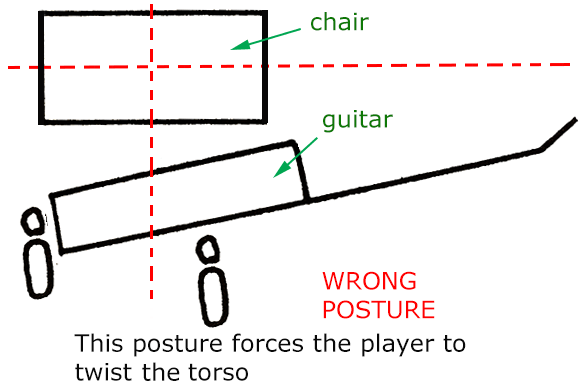
It is funny because in his guitar method, Parkening describes the exact opposite as RIGHT. In 2014, Parkening had to retire from concertizing because of serious lower back related problems.
Carlevaro Guitar Technique Compendium
I will focus next on guitar technique concepts. The only guitar technique treaty that captured my imagination in the many years I have been studying guitar is Abel Carlevaro's "School of Guitar". I will shed my personal views on technique enlightened by the fascinating insights of Maestro Abel Carlevaro.
The only technique I can dare to describe is my technique: Renato Bellucci's technique. My technique has little to do with Carlevaro's. So does my playing. We share a deep hate for left hand squeaks and no place in our lives for appoggiato -rest- stroke. My left hand -arm- is definitely Carlevarian, so is 50% of my right hand and an equal percentage of my overall body sitting position. Where we are practically 100% equal is in our way of going to the heart of the matter. I learned to think as a player with Carlevaro because he was a true intellectual. Many times, my way of achieving results was totally opposite to Carlevaro's. Yours will probably be too. Remember that we are all equal but not all the same. I never liked some of Carlevaro's sounds (he developed and/or described 5 different right hand sounds). He used his personal taste and uniqueness and the only person he had to convince was himself. His conviction was contagious. When he saw other ways to do things, he observed. He made sure you were conscious of the decisions you were undertaking and approved. You had to show him you were convinced and that was all that mattered to him. When you think before playing and observe everything carefully you are using Carlevaro's Technique or Carlevaro's Approach even if you reach different conclusions or use different mechanical concepts to solve a musical phrase.
Most of the Uruguayan Master concepts are Universal. Of course, intelligence is universal ! The degree or type of intelligence may differ but we all know what is. When School of Guitar was first published in Argentina in 1979, it presented Carlevaro's way of playing and why. When I worked with Carlevaro in the late 80's, he would often "edit" these concepts to make them applicable to me. What he achieved though, was a lot more. He planted the seed of search and curiosity in me which would set me on the right path. The one path that would lead me to my best playing. Therefore the following chapters can be classified as "Carlevaro's way of thinking revised by Bellucci".
Being close to him, I realized that some of the concepts that seem to be very rigid when taken from his books, are actually much more flexible and it is very important that the guitar player keeps in mind that every single rule has to be filtered by each individual's unique built and musical taste. This is exactly what I will do teaching master classes learning real pieces with you and solving the technical challenges using my brain, just like the master taught me.
Getting to know Montevideo and the Uruguayan musical scene is very important when one tries to understand how and why a musician of Carlevaro's stature approached guitar playing in such a scientific and universal way. At the beginning of the 20th Century Uruguay was often referred to as the South American Switzerland. A strong imperial English hand, left its marks in many of Uruguay's customs. Top European immigrants at the turn of the 19th Century gave Montevideo and Uruguay in general, a character that is simply non existent in neighboring Argentina or Brazil. The illiteracy levels in Uruguay are almost 0. That says a lot especially when in many countries there exists a generalized idea that all South America is the same... therefore third world classifiable.
PLAYING POSITION: On Sitting With the Guitar
Most guitar methods and treaties start dealing with the proper way to sit holding the guitar. Carlevaro is no exception. The main difference to his approach, as compared to many others, is that he brings thorough knowledge of anatomy, physics and common sense into the equation. He begins describing BODY POSITION it is not dealt with as a mere matter of posture but as one of balance and equilibrium between the instrument and the player.

The first objective to be achieved is: to hold the guitar perfectly still allowing for full freedom of movement for the player.
As opposed to the traditional school, Carlevaro states: "The guitar must adapt to the body, not the body to the guitar". Each player must take into account his or her unique characteristics and the guitar must adapt to these.
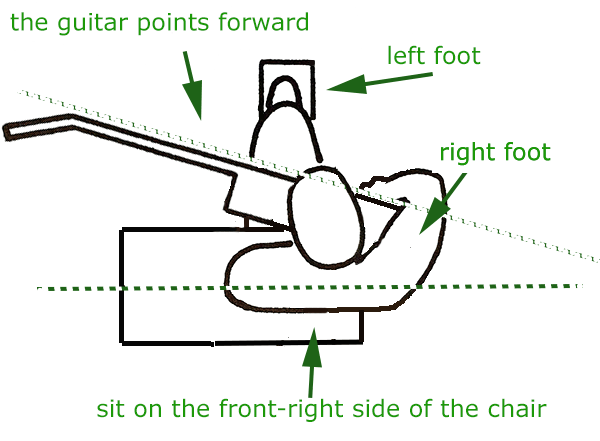
Back pain is one of the most frequent complains of guitar players all over. Carlevaro realized that the main problem was the "placement of both feet forward". This is a very unstable position that requires the back to make an enormous effort to maintain the balance. By setting the feet properly, one in front and the other behind, the player will be able to move his whole body by simply pushing on one foot or another. Not applying pressure on either foot will mean stillness.
In order to be able to sit with your feet as shown in the figure below, you will have to sit towards the front-right side of your chair (4 legged chair) in order for the right foot to be free to go behind you.
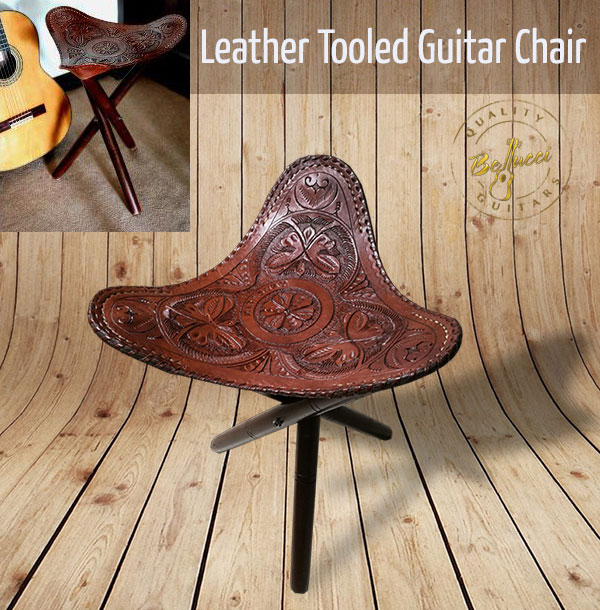
In downtown Asuncion, they have this chair (image below) on sale which I and a few of my students have bought. It deals with the 4 leg issue of standard chairs, plus it is anatomically comfortable, light and is made of sturdy leather and wood. It can be folded really easily and carried everywhere. It allows to play with no footstool or with very low setting on the footstool (only 17 inches from the floor to the butt). Click on the button to the right if you would like me to purchase and airmail 1 to you.
US$ 189
Remember that when you are discovering your sitting position you must consider all the possibilities with great flexibility. A faulty sitting position is at the root of a faulty technique and poor musical expression. "The left arm must be totally free to move in order to help the hand and the fingers in every way." Carlevaro will never refer to fingers literally. To him fingers' movements will always include arm-wrist-hand movements and in a more indirect way the muscles of the upper torso and legs.
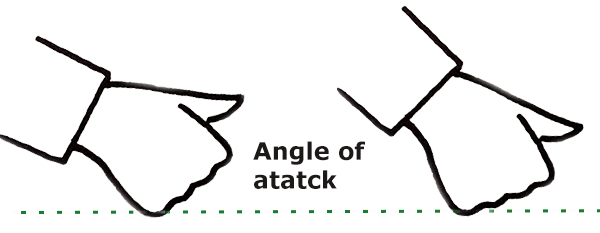
In order to attack the strings at the correct angle (the angle where the best sound is produced) "the wrist must be kept as straight as possible; raise or lower the guitar, rotate it between the legs, adjust it until the fingers can produce the most efficient stroke as naturally as possible."
A correct sitting position plus 3 points of contact between the guitar and the player is what I call a great start.
When you are playing, 5 points of contact are established between the player and the guitar although only contact points 1, 2 & 3 are necessary to keep the guitar in place.
1) The left leg.
2) The right leg.
3) The right arm.
4) The chest.
5) The left arm.
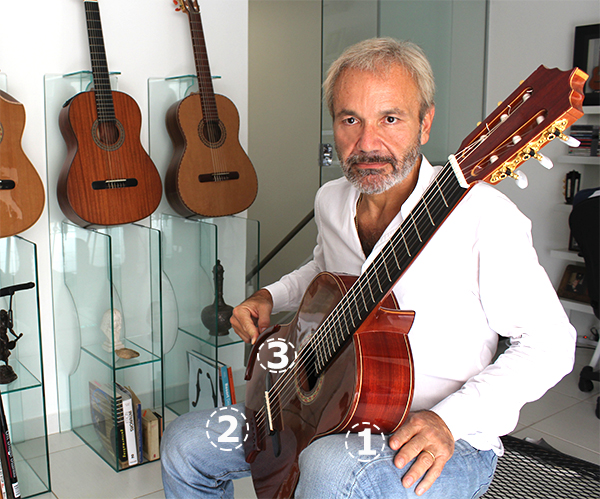
These 3 contact points between the guitar and the player will keep the guitar in place.
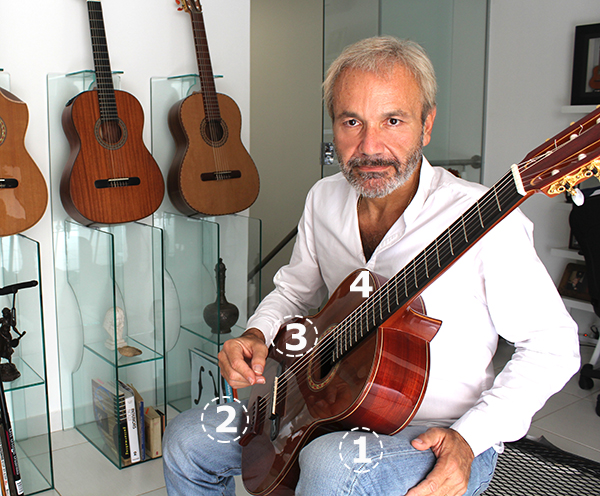
The chest and forearm make contact with the guitar.
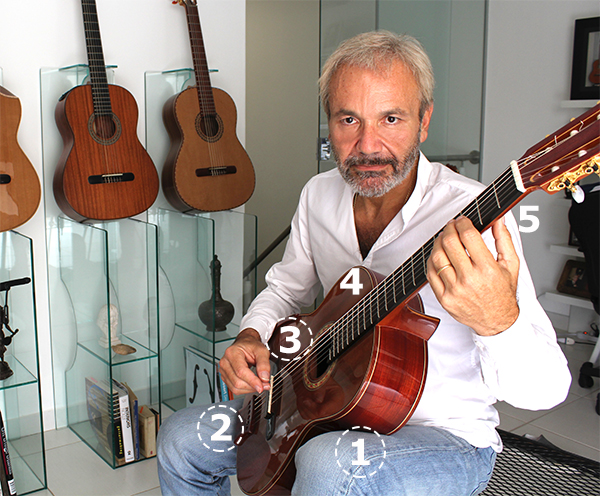
Finally, the left hand makes contact with the neck of the instrument.
Angle of Attack
The guitar has been around for a long time before anyone ever considered to play classical music with it. Therefore, it is not surprising that several guitarists have come up with ideas to help better hold the instrument on the left leg. The curved shape on the lower side caused an anatomical problem. Carlevaro used a small cushion on his left leg to lift the guitar more. I tried and played with a cushion myself for a few years but the cons were far superior than the pros. Carlevaro was a fragile built person. I am big. The guitar moved too much on the spongy cushion and lacked the necessary stability for me. Plus, I did not like the sound I produced with my fingers at a 90 degrees angle with the strings. Carlevaro played at 90 degrees and his sound was great. Some of his students that copied the 90 degree approach developed an unpleasant sound. The type of nail has a lot to do with the angle of attack.
Instinctively, the guitarist feels as though the curve has to fit the upper part of the left leg. If you observe closely, you will notice that by following this instinct you will be forced to twist your upper and lower torso. Your right arm will tend to cover the upper side of the guitar pushing your right elbow up and dumping the guitar sound. This position only allows the player to see the sixth string. In the picture to the right you can see that the guitar points upwards allowing for the 6 strings to be visible. The lower curvature is totally ignored and the guitar makes contact on its inner ring. The lumbar area is relaxed and so is the right shoulder.
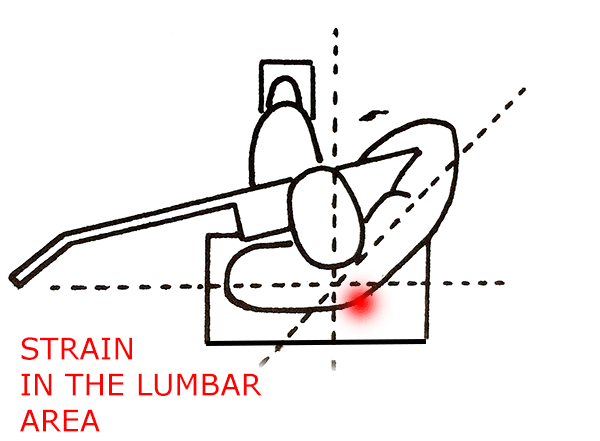
"Body movements must not affect the balance of the instrument. A degree of body motion is necessary when certain technical demands are placed on the left hand and arm". The feet are the main motors. They act as levers. The right foot comes into action when left forward movements of the body are required. An opposing force in the other foot will restore the equilibrium. Avoid all tension to the spine since tension from this area spreads like fire to every part of the body. The weight of the right arm is a point of contact in itself. Do not apply any downwards pressure. The right arm will work like a pendulum whose vertex is the elbow. Sit with the guitar and check to see where you get the most comfort and fluidity of playing and the less muscular tension.
Sitting correctly is probably as deep as I will get into technical jargon. Next we will learn Cavatina. I will finger it and explain the whys behind my decisions. The video will help you and me feel closer than we really are and definitely illustrate every concept as clearly as possible.
In Depth View of the Right Hand
Below is an animation of what your Right Hand should look like 95% of your playing time. In the animation I am playing an arpeggio formula: a-m-i-m. Notice how the movement comes from the main knuckle and how there is very little jumping or side-to-side movement coming from the hand.
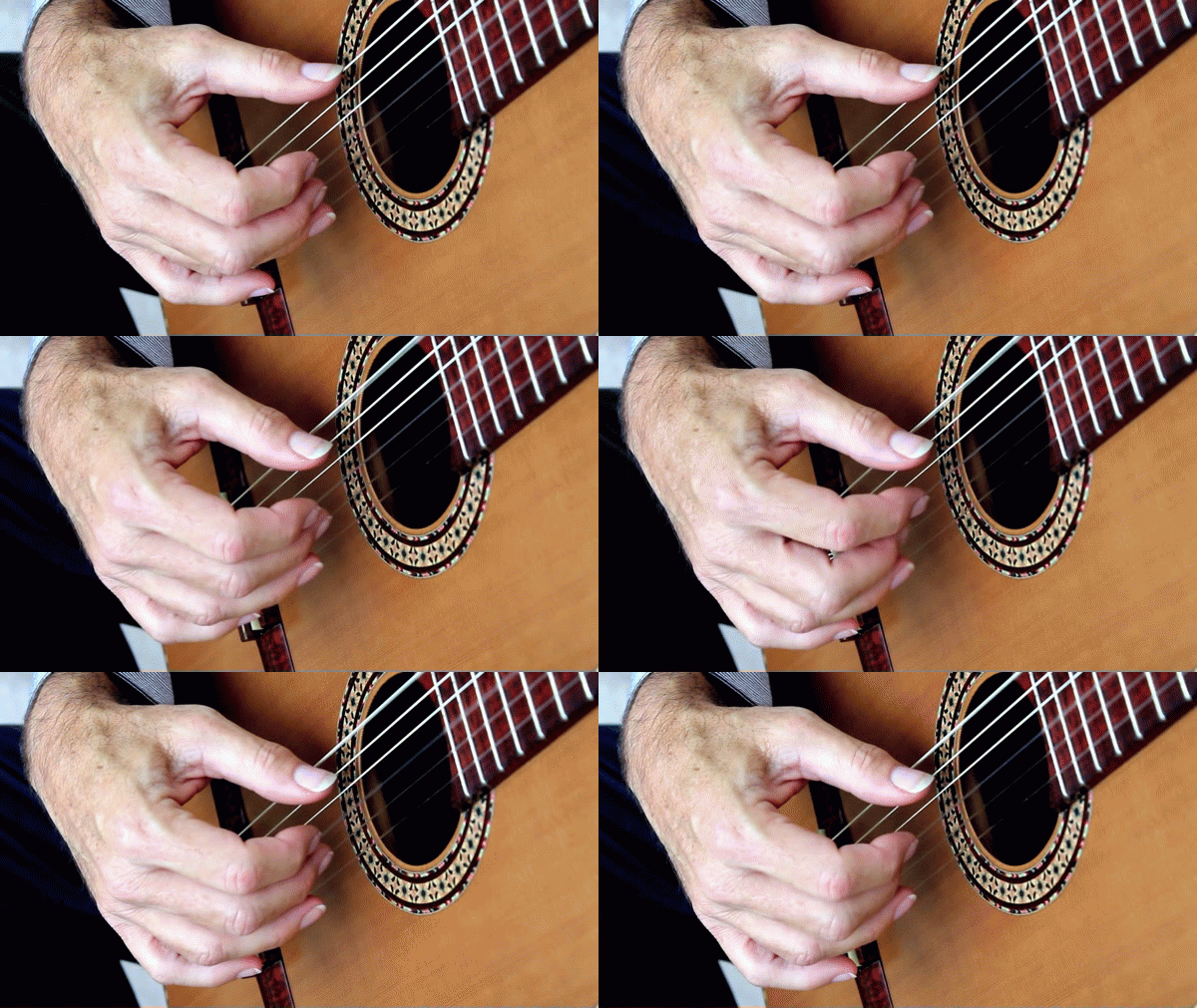
Below I show what is the Right Hand movement that your audience sees when they are looking at your play from the front. The fingers close inward in a fist like motion and typically people are struck by the fact that "so much music can be produced with so little movement"... The fact is that the proficient guitar player uses just the right amount of energy and wastes very little of it and every move is optimized to the maximum.
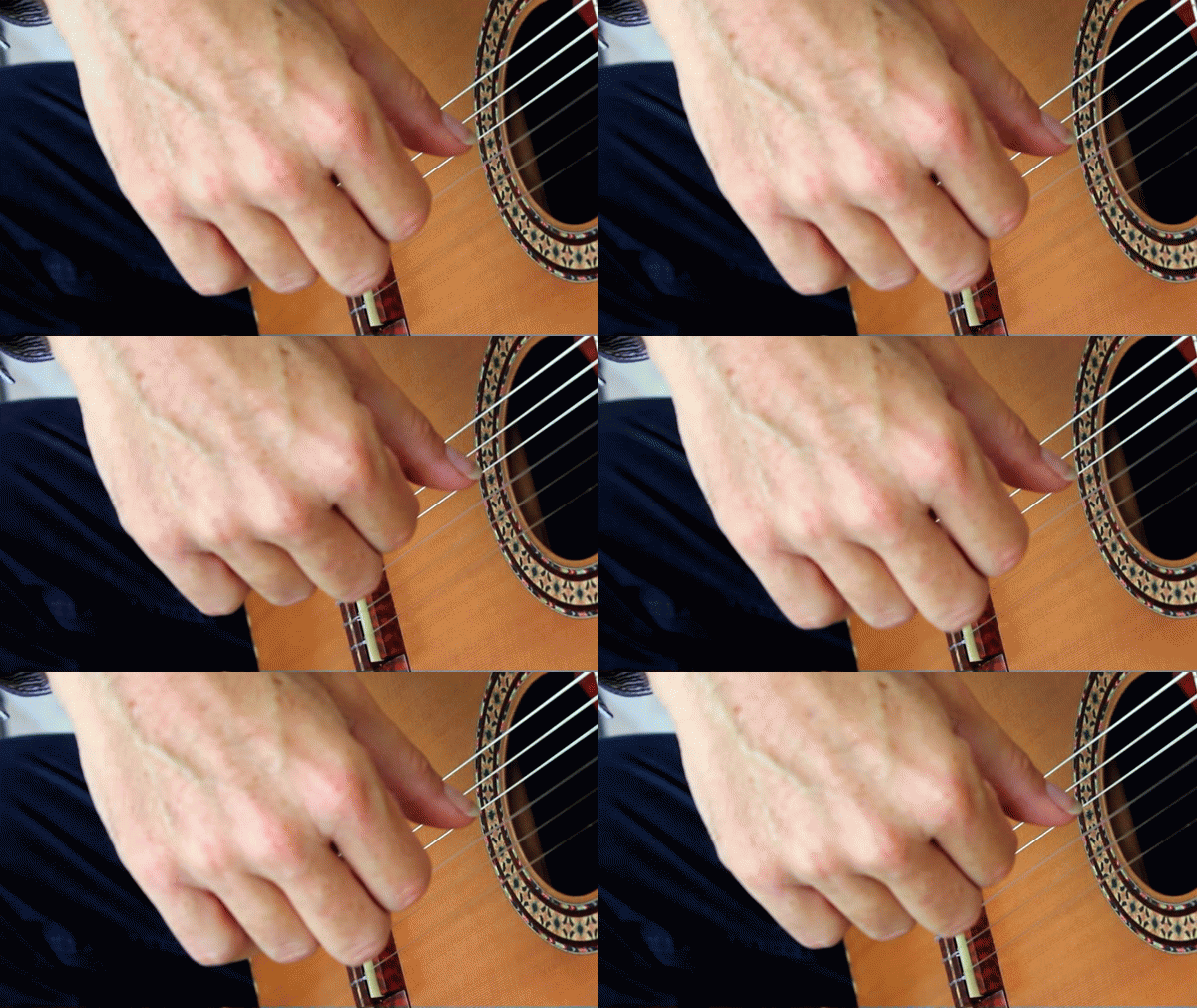
The right hand creates a unit with the left hand. 99.9% of our playing mistakes originate in the right hand. Therefore, not giving both hands an even share of attention will definitely create havoc. Guitar is about syncronicity. As we acquire more security with the instrument, we tend to forget the right hand. We take for granted that it will work properly whether we keep a certain degree of control over it or not. This does not mean that we have to look at the right hand (only look at the right hand in a mirror until you have acquired the right position). What this means is that we have to finger the right hand as thoroughly as the left hand and stick to the fingering in the memorization process. Doing otherwise is mistakes in concerts 100%.
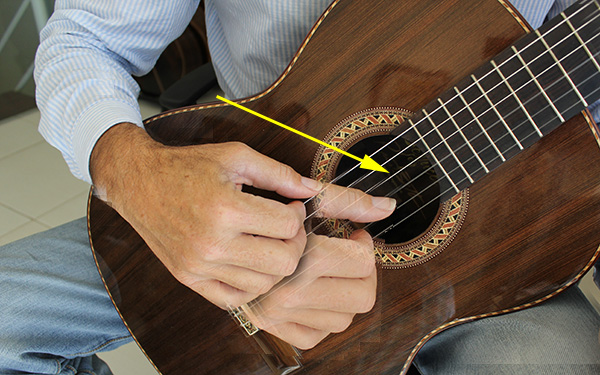
The guitar player must keep the wrist in the same posture to keep the sound steady and uniform. Avoid twisting it at an angle at all costs in order to prevent strain to the musculature. The angle at the wrist may only be changed when the player wants to deliberately change the sound. Changing the angle at the wrist will cause a lot of mistakes to enter your playing. The forearm slides up and down on the upper bout in order to bring the fingers up and down across the strings in scales or arpeggios. A pendular motion of the forearm with a change in the angle at the wrist can be used for fast tremolo.
The placement of the guitar determines the way the strings will be attacked by the guitar. The factors that decide the correct placement of the guitar are: the shape, thickness, hardness and flexibility of your fingernails, your body size, fingers length and your personal taste concerning sound. In the drawing below, you see that the point of contact between the guitar and the player is the forearm which will be sliding up and down in order to keep the curvature of the fingers constant, especially during the performance of scales.
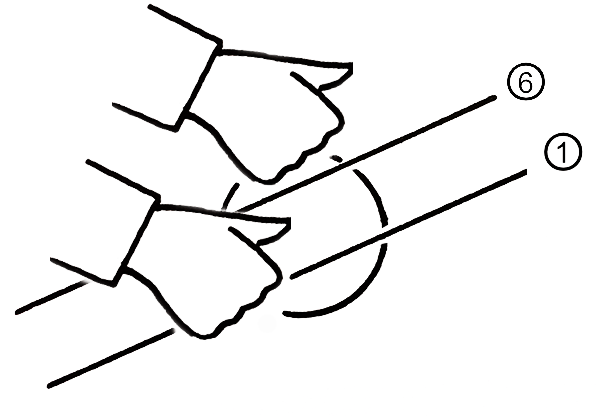
Right Hand Fingers Point of Contact With the Strings and Moving Parts
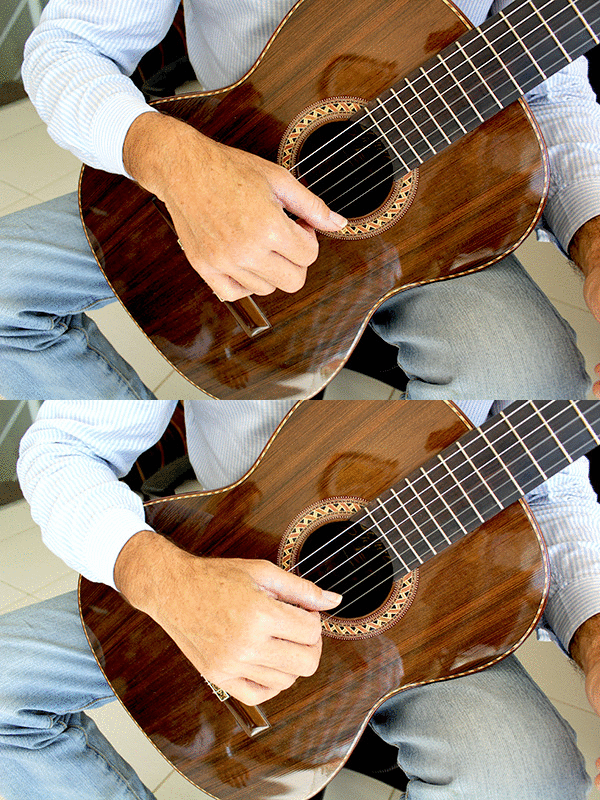
Whenever you play a string, you should first feel the string with the flesh right under the nail and then struck the string with the nail. It is a double action and it happens so fast that all we actually hear is the note being played. The idea is that the flesh stops the string from vibrating before producing a new sound. If you do not do that, it is very likely that you will hear a clicking sound when you play especially in recordings. Planting or Feeling the string will also help you keep the right hand as close to the strings as possible.
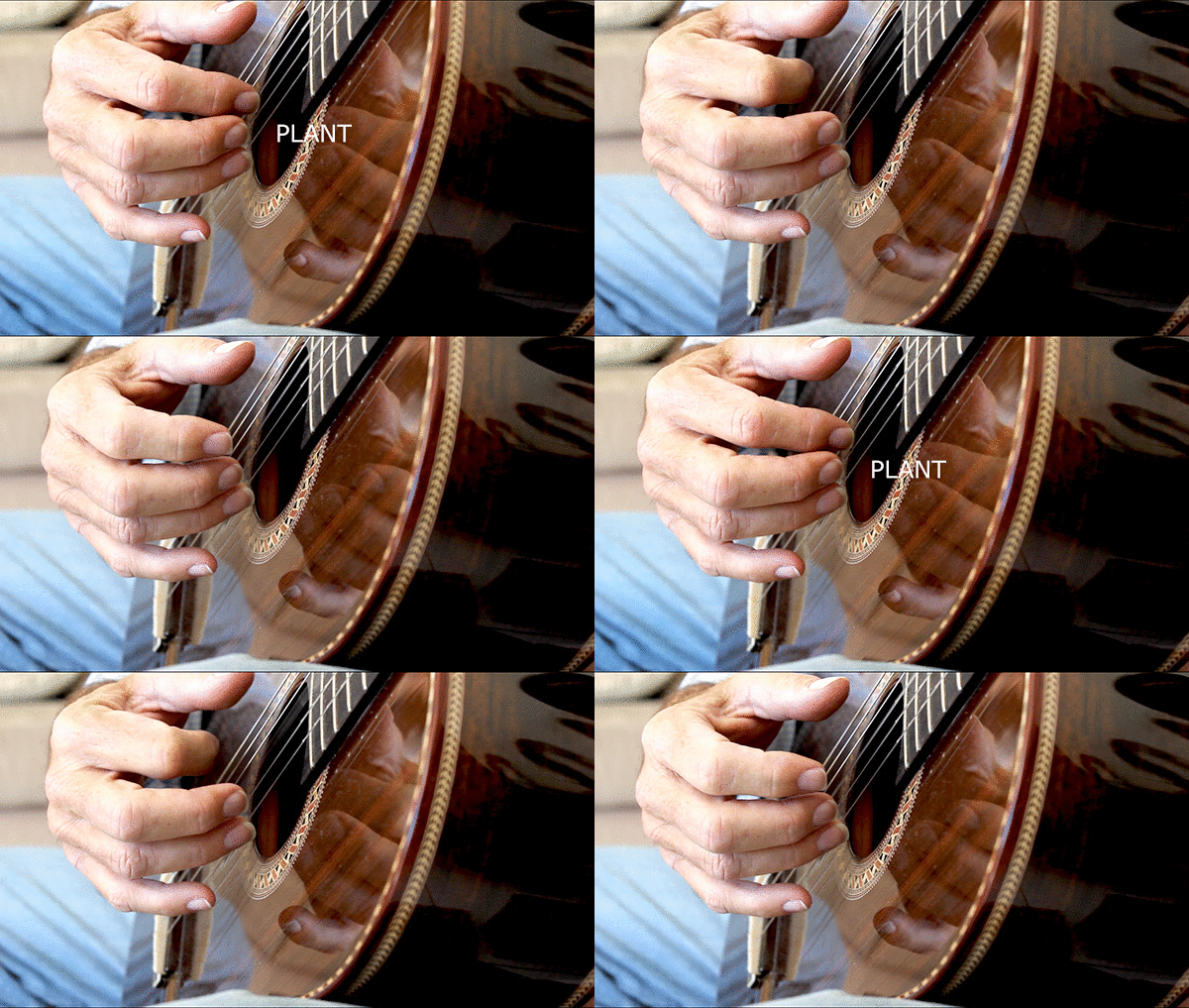
In the two pictures below, what I do is squeeze 4 strings with my right hand fingers and then see the angle created between the string and the nail (angle of attack). You will see little canals formed on the fingertips, that is the point of contact prior to the attack to the string.
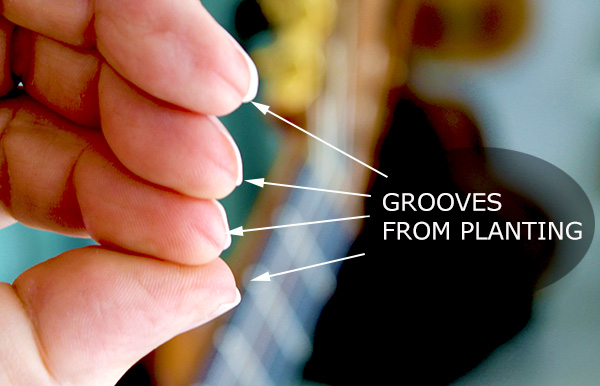
The image shows the place on your fingertips where PLANTING occurs. Read more on PLANTING here.
This angle is the key to the quality of your sound. Your nails will have to be shaped according to your unique angle of attack. This peculiar nail filing will prevent the nails from hooking and at the same time allow you to feel the string with the flesh.
The muscles and tendons that move the fingers from the main joint (the main knuckle is the green spot in fig 1) are located in the forearm. These are the most effective muscles for the job. Energy is only needed to close the fist. Cutting the signal will bring the finger back to its ready position.
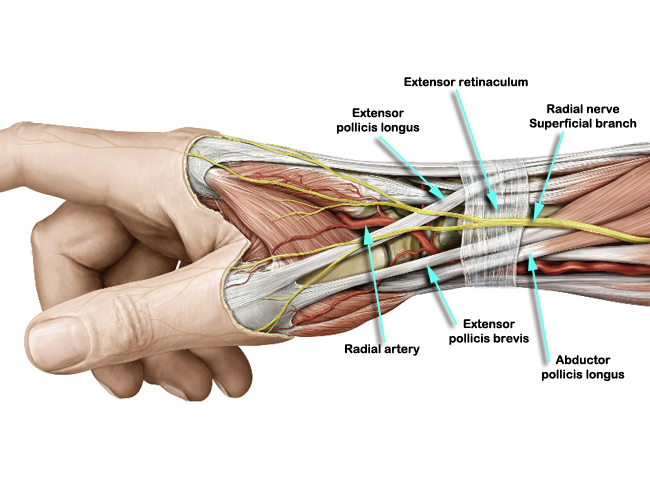
The tense-flexible band around the wrist -picture above- is responsible for keeping the tendons tense which in turn helps to bring the fingers back to their relaxed position after work.
SOUND
The most important thing for a musician must be the quality of his sound. Below, I show how to play a chord moving the fingers from the main knuckle in the right hand in order to produce a full, round, bell-like sound.
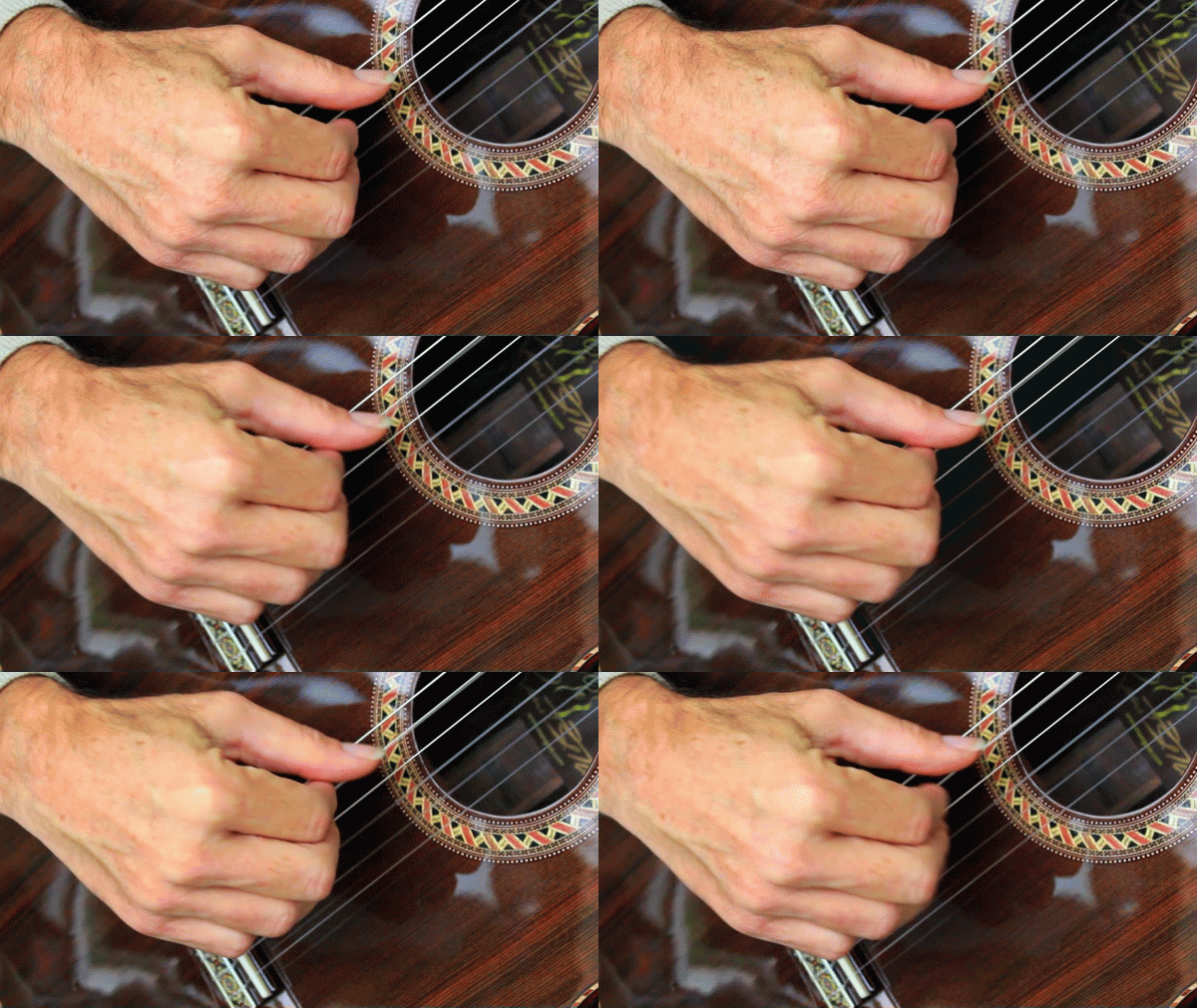
The p, i, m & a fingers makes contact with the strings (planting). The signal is sent for the Right Hand fingers to close inward, in a fist like motion. The finger comes close to the palm of the hand. Tension is released so as for the p, i, m & a fingers to return to its relaxed position.
The sequence shows how the a finger makes contact with the string, immediately after pressure is applied and the strings are held between the flesh and the fingernail (planting). The player feels the string with the flesh. The right amount of pressure is applied until the desired volume is achieved before the string is released. The angle at which the attack to the string is performed, will decide the color of our sound. The muscles and tendons shown here are responsible for closing the fist. If you move a finger from the main knuckle, you will feel and see the tendons and muscles move in the palm side of the forearm.
More On Sound and the Technique of the Right Hand
To a classical guitarist, the right hand is the equivalent of the vocal chords to a singer. Depending on how you use it, your sound will be more or less beautiful. It will be more or less rich in textures and in turn, will give your sound more or less depth. The sound will be the sum of the angle of attack to the string (green line in the 3 frames below), the amount of nail and flesh involved in the playing, the type of nails and their shape that they have and the right hand finger you decide to use in order to pluck a given note at any given time. This is what I have noticed throughout 33 years of guitar playing: Players becoming so obsessed with fear of mistakes and speed that sound, the only real important issue, has taken a back seat. The first musician that is known to have called the guitar a "miniature orchestra", was the composer Hector Berlioz. When I think of the several names that have been given to our instrument, I think this is the most appropriate. Carlevaro mentions this phrase when he starts describing the key function of the right hand in the process of sound.
"Sound is the most direct manifestation of an interpreter's personality".
Abel Carlevaro students, myself included of course, have been formed as classical guitarists believing that the guitar is like a "miniature orchestra". I remember learning Bach Chaconne in Uruguay with Maestro Abel Carlevaro and he would point out things like "imagine this melody being played by a trumpet... This melody by a cello... and so forth".
The right hand is also the place where most of the playing mistakes are generated. Keep the work of the right hand tidy, well organized and consistent. This method will ensure that your technique will grow in perfection.
One way that I would practice a piece or re-examine an old piece from my repertoire is to play the piece in a way where I would force myself to use different finger for each of the 6 strings. The a finger would play on the first string, the m finger on the second and the i finger on the third. The thumb would cover strings 4, 5 & 6. By doing this, I would be leaving nothing to chance. In other words, I knew exactly which right hand finger was playing which note at all times. When I felt that the single finger could not cope with the workload on a given string or if the flow of the music did not sound smooth, I would see that a complementary finger share the work on that particular string.
The concept of sound and color have been around for many years. Sounds are, to the trained ear, colors. The more we train our ear, the wider will be our palette of sounds. That is the reason why great composers used so many tonalities. Each one of them told a similar story in different colors. For us guitarists, the whole tonality issue is core. We play a lot of transcribed music. Often, when passing from one tonality to the other, we are changing certain very peculiar nuances of a given tonality. Think of it this way. You look at a color picture portraying your loved one. A few moments later, you change the picture for a black and white picture portraying the same person. Everything will still be there, we will know exactly who we are looking at only that different parts of our intellect will be struck and the overall impression will be different. The performer has to think sound and then make sound. The colors he will use will help him convey the story.
Exercises for the Right Hand
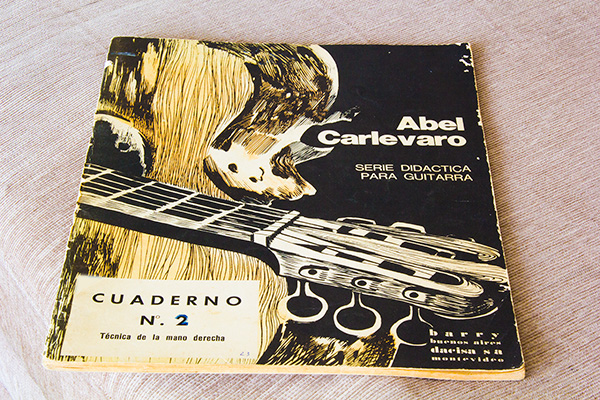
In the videos below Below I explain in depth a series of marvelous exercises I studied with Maestro Carlevaro in Montevideo in the mid 1980s. The exercises are part of a fabulous collection called "Serie Didactica", which consists of 4 exercise books containing work for both the right and the left hand.
Video Part 1
END Part 1
PART 2 PART 3 PART 4 PART 5 PART 6 PART 7 PART 8 PART 9
The continuation of this class is in the members area, become a member today.