Back to Top

Learn how to read music notation
Learn How to Read Music Notation
Learning how to read music is very easy. If you look at a guitar player reading through music and then you get the music sheet in front of you, you will probably say "no way I can read these hieroglyphics!". There is a clear cut difference between sight reading at tempo and simply reading. The second one will eventually lead you to the first and for practical purposes all you want is to be able to decipher those symbols which are really few and really straightforward.
I blame teachers both in schools and music schools for the bad reputation generally associated with music notation. The problem there is that most teachers impose reading simultaneously with guitar learning as soon as class 1 starts. That is as if we tried to teach a baby how to read before he can say mom... You first get a student up to a decent playing level and once the motivation (KEY ELEMENT) and self esteem are built up, you introduce music symbols and their interpretation. The student should get to a point where he wants to read music.
He (the student) approached you (a guitar teacher) to learn how to play guitar and not to be tortured with theoretical jargon. Having said that and hoping you still have a little interest in how to read music, I will show you a very simple process that works and that can evolve into whatever level you are willing to. I divide reading music into stages and whatever stage one learns, I guarantee music reading proficiency.
The first stage in reading music is the one where you know the tune (I mean you heard it and are familiar with it) and want to play it having the music sheet in front of you.
In your life as a musician, you will seldom want to learn a piece you never heard before unless you are preparing for a competition where a new work is being commissioned for the competitors to première.
In stage 1 all you need is to figure out where and how those dots, numbers and markings on the staff translate on the fret board. There are only a few basics that will make the whole process real easy. You only have to KNOW a few things.
The music staff (the five horizontal lines, also known as leger lines) show you how high or low a note is. The third line is a mid point. This mid point is the open second string of the guitar a B -Si- (the strings of the guitar are counted starting from the bottom and going up).
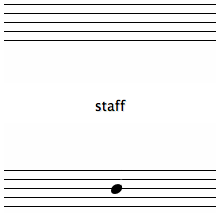
Mid-point B (Si) = second string of the guitar.
All you need in stage 1 is to see dots and their height on the staff. When reading music in stage 1 (knowing the tune) you do not care whether the dot appears in any of the following ways:
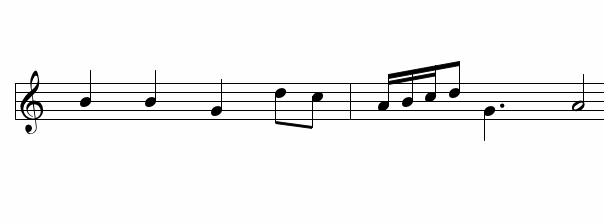
Mentally eliminate those lines, small dots, white notes, etc.
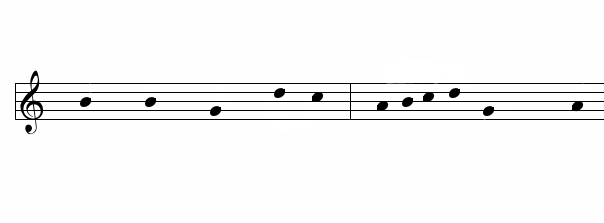
All you care about is the dots.
The next thing you have to know, because it reveals much more than simply a stylized drawing is the following:
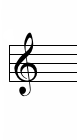
The reason why this symbol (G clef Clave de Sol) is so important is that it actually is the KEY that breaks the code. Music notation is a code. The way it breaks it is by saying the following:
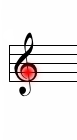
The red highlighted zone within the curl is encircling the spot where G is located: The second line (lines on the staff are counted starting at the bottom and going up); Therefore:
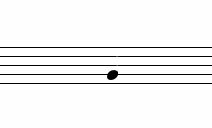
This dot on the second line is a G the open third string on the guitar.
With the knowledge acquired so far you can say with all certainty that you know the following:
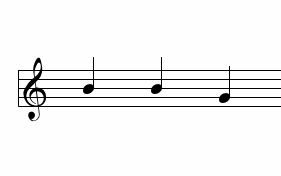
The notes are B, B, G which means you play string 2, string 2, string 3
To play, guitarists use 4 fingers in one hand and 4 fingers on the other. Every 3 decades or so, and especially if you are a show off, you will probably have to use 5 fingers on one hand, but when that time comes you will know how to deal with the issue and you will probably not be reading this page... Having said that, the way we guitarists refer to the strings and to the fingers of the hands involved in the production of a sound is the following:
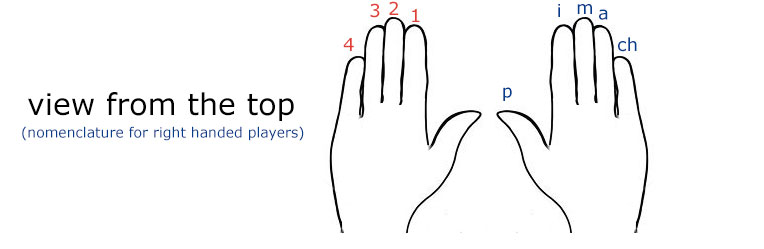
Once you know by heart these few "things", the next thing you have to memorize is what the 6 strings of the guitar look like on the music staff and what their names are. Knowing by heart these 6 notes (which by now are only 4 since you learned B and G) plus a little logic and common sense,, you will figure out every single note on the fret board in no time.
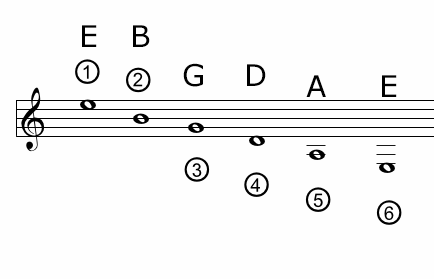
Play every E, B, G, D, A and E from any music sheet that you have at hand.
By now, you can recognize 6 dots immediately and their location on the strings. They are the 6 open strings of the guitar. YOU KNOW that the existing natural notes are 7: A B C D E F G (Do Re Mi Fa Sol La Si). All existing notes, EXCEPT for E and B, can be altered using sharps #. (Flats b are explained a little further down).
therefore, the natural notes plus the "altered" notes are add up to 12 notes.
A/A# B C/C# D/D# E F/F# G/G#
Sharps translate into: Fret x + 1 fret. If fret 1 on the 6th string is F (it is) then, fret 2 on the 6th string is an F#.
All existing notes can be flatted (although 99% of the time the only flatted notes you will see are E and B). Flats translates into Fret x - 1 fret. If fret 3 on the 5th string is a C (it is) then fret 2 on the 5th string is a Cb. For practical purposes, use sharps when counting up and flats when counting down from any given fret.
A/A# B C/C# D/D# E F/F# G/G# G/Gb F E/Eb D/Db C B/Bb A
Flats and Sharps are the black keys on a piano. They are meant to give us more "colors to play with". Therefore, when you count up and down the fretboard, you must count this way:
A, A#, B, C, C#, D, D#, E, F, F#, G, G#. Every time you count a whole set from A to A, you have counted what is known as an octave.
You know that E shows up on 2 of the open strings of the guitar (strings 1 and 6, hem, hem), that means that 2 of the 7 natural notes are missing from the 6 open strings... C and F.
Where are they? Hellooo... start counting up and down and find them on the fretboard and you will have learned how to read music notation.
These Are the 22 Most Played Notes On the Guitar
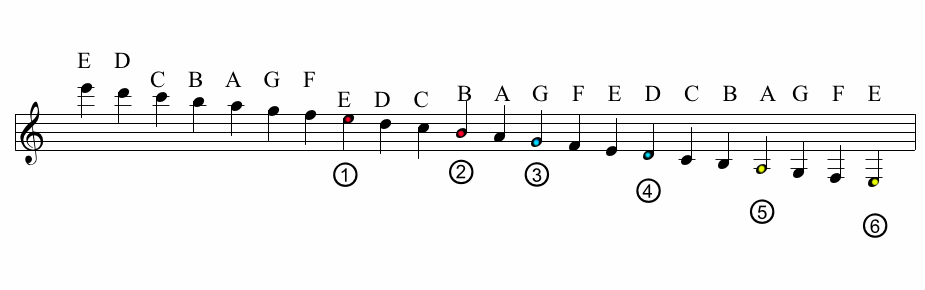
You have no excuses to hide behind tabs anymore. Tabs are ok but they are primitive and offend the intelligence. They are the equivalent of telling a surgeon to operate using a stone used by the Neanderthal man when a platinum scalpel is sitting right next to him ready to be used. Plus tabs will make you feel guilty and more guilty the older you get... You will always know that something is missing for you to feel like a complete musician. You are cutting yourself out of the world of music for not wanting to invest 2 hours of your life to learn music notation. Do not underestimate yourself so much. Just to let you know, tabs are actually the best way to cut your wings as a musician and musicians are meant to have wings. 2 hours investment... remember 2 hours.
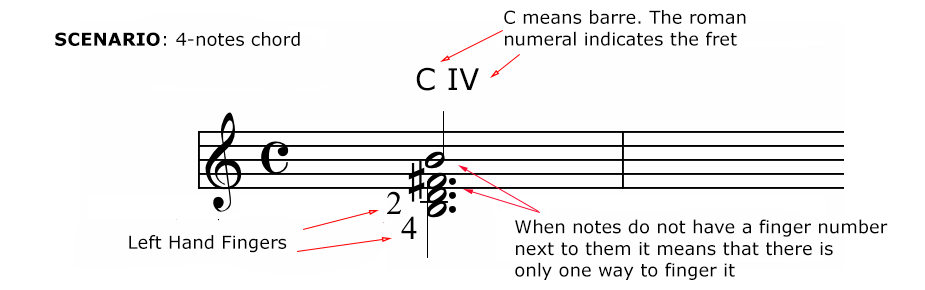
While you brainstorm these elements I will translate into playing several music notation scenarios from a guitar music score. Remember, there is always a small percentage left for your intuition and intelligence to come into play...
Challenge: Using your good taste alone, you could modify this chord a bit and play it in different positions on the fingerboard... This will free your hand from the barre and several possibilities will suddenly pop- up... do not be afraid and experiment... the more you develop this "instinct" the better player you will be... I will give you a couple of days to think... This flexibility in playing is impossible to achieve with tablature.
This is the best and most efficient methods to spot notes on the fretboard.
This is a very clear example showing the power of music notation. Music notation provides freedom to the musician. At the same time, we guitarist need to be familiar with the different fingering scenarios possibilities. This flexibility is among the key elements that allow guitarists to taylor their playing to their unique taste and physical built.
"When talking about reading music, you show the 22 notes that are used 99% of the time. Im very confused because there are 78 different places to play notes... I guess what Im asking is... if a note is to be played on the 5th string at the 8th fret, that's an F, but I don't see where the standard notation tells you that it isn't the 6th string or the 4th string".
There is a high degree of logic and intuition in music notation. Music notation is ALWAYS associated to fingering and vice versa. Therefore, the notes must ALWAYS be played in the most obvious fret/string location unless there is a number in a circle indicating otherwise.
As for right hand fingering, it is always safe to let the thumb take care of the lowest note (B in this case), and the i-m-a fingers take care for the following notes. In the first example below, B is played by the thumb, D by the index and B by the middle finger. Right hand fingering will be dealt with later on. The above rule serves the purpose for the time being.
The continuation of this class is in the members area, become a member today.