Back to Top
Tonewoods Properties
Tropical woods are all very dense and have similar tone characteristics. The reason why some are more expensive than others is in relation with the rarity of the wood and the resistance that the wood offers when it is worked by the luthier. It is not the beauty nor the sound that these tonewoods deliver the reasons why some are more expensive than others.
Aesthetically, it is a very personal choice that inclines you to have a preference for darker Vs. lighter woods, or highly flamed cuts Vs. more uniform cuts.
When it comes to choosing the wood for the back and sides and for the top, you may feel a little lost because you do not know what is more convenient for you. Here, I'll be explaining the factors to be kept in mind when you make your choice.

Go Back
to top
African Blackwood
Weight: Heavy
Wood Properties and Sound
See a sample African Blackwood guitars here → and here →
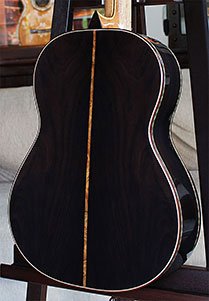
The Deepest basses, well defined trebles, excellent tone wood, very responsive, with a terrific tap tone. I find the mid-bass ranges of this wood to be very human-like in quality. The most expensive of all the tropical woods. It is also the one guitar sound that is really different from all the rest. Macassar Ebony, Maple and Walnut deliver very similar acoustic results at a fraction of the price of African Blackwood. African Blackwood is a member of the Rosewood familyhas long been credited by guitar builders as the ”holy grail” of tonewoods. With a strong responsive taptone that surpasses even Brazilian Rosewood, it can contribute significant volume, power and clarity of sound to a guitar. African Blackwood is very difficult to work and very hard to bend, but it is strikingly beautiful and polishes to a high luster. African Blackwood is a small tree and as a result, obtaining guitar sets is difficult and this is the main reason why it is such an expensive tonewood.

Ambrosia Maple
Weight: Light
Wood Properties and Sound
See a marvelous Bellucci Ambrosia Maple guitar here →
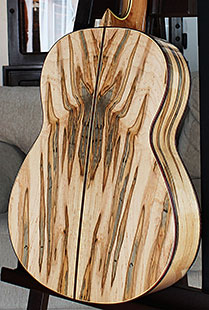
Ambrosiaa Maple is essentially a regular Maple tree that has been co-living with a liken called "Ambrosia" that is responsible for the blue, turquoise and beige coloration of the grain. The liken is transported by a small beetle. It is quite stunning and shows nature marvelous way of making art I was able to get a hold of this beautiful wood for the first time and I know it is quite rare to come by. It is the only wood that can offer a turquoise/blue coloration and it is because of the collaboration of this unique liken. The sonorous qualities of the wood are identical to standard Maple:Strong, well defined bass and clear trebles. Ambrosia Maple is not always readily available but given enough time I can always get a marvelous set on request.
Bastogne Walnut
Weight: Medium
Wood Properties and Sound
See a marvelous Bellucci Bastogne Walnut guitar here →
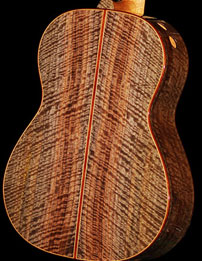
Bastogne Walnut is a rare, natural occurring hybrid between California English Walnut and Claro Walnut that is found in typically northern California. It can vary greatly in figure and color but is usually a rich dark brown with some very dark and swirly figuring almost as dark as black.
Bastogne Walnut is a very strong, heavy wood and is the densest of all walnuts. It takes long to dry but is not as difficult as Claro walnut. Because it is so rare, Bastogne walnut is highly prized for making fine musical instruments and the rich bass, perfect separation of voices and sustain it offers is living proof of that. I started sing this amazing wood in mid 2013 and I am a declared fan.
Black & White Ebony
Weight: Medium Heavy
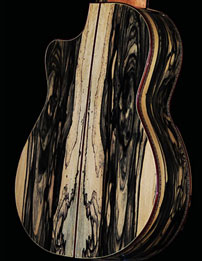
Black & White Ebony, Cambodian Ebony
Black Limba
Weight: Light
Splendid Wood
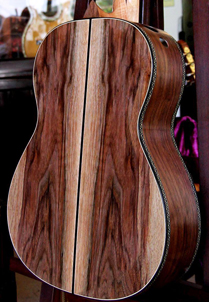
The Heartwood is a light yellowish to golden brown, sometimes with grey to nearly black streaks and veins. Wood with such darker figuring is referred to as Black Limba, while plain unfigured wood is called White Limba. Sapwood is a pale greyish to yellowish brown, not clearly demarcated from the heartwood. Color tends to darken with age. This wood goes by a number of names, and historically has been called Afara or Korina, in addition to its now-prevalent moniker Limba. Great sustain and punch in every Black or White Limba guitar I built to date. See a Bellucci White Limba HERE>>
Bloodwood
Weight: Medium
Wood Properties and Sound
See a marvelous Bellucci Bloodwood guitar here →
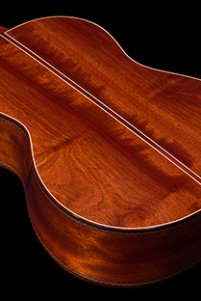
Bloodwood is a Tropical South American wood with extreme density, and has a pronounced blunting effect on cutters. The wood is not easy to be worked and calls for experienced luthiers. Those persistent enough to bear with the difficulties of working with Bloodwood to the finishing stage are rewarded with an exceptional and lustrous red surface and the amazing sound it offers to the finished instrument. The bass is always clear and crisp with a punch whilst the trebles and mid ranges are perfectly defined and sustained. The color is reminiscent of the vital fluid it refers to and typically, when combined with Spruce, i creates some astonishingly beautiful instruments.
Bocote
Weight: Medium Heavy
Striking Woods
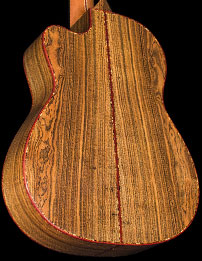
Bocote, with its striking, Zebra-like contrasts, and bold figuring, can be a very eye-catching wood. See a Bocote Guitar here → . Bookmatching two consecutive panels can create symmetrical “faces” and other patterns in the wood, (though a relatively thin-kerf blade should be used to minimize the shift of the pattern). Bocote is perfect due to its aesthetic attributes, and its tonal capabilities—and although Bocote is relatively heavy and delivers well balanced guitars. (It is roughly as stiff and strong as Hard Maple, even though Bocote is considerably heavier.) Click here → to admire one of my best Bocote Masterpieces to date
Brazilian Rosewood
Weight: Medium Heavy
Wood Properties and Sound
See a marvelous Bellucci Brazilian Rosewood guitar here →
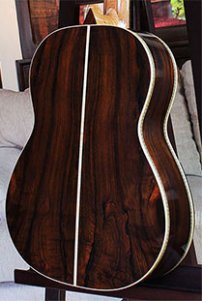
Brazilain Rosewood (Dalbergia Nigra) is often referred to as the "Rolls Royce" of Tonewoods. It has earned the reputation after having delivered some of the best instruments of the past century. Still, the speculation around the species has made it so expensive that I think the luthier is better off using African Blackwood and other not so "speculated" species. Everything abut the tone of Brazilian Rosewood is practically speaking a dream type of sound. The species needs quite a bit of pampering when it comes to humidity therefore, if you are not the type of good carer that the species requires, I suggest you use more sturdy Tropical Tonewood.
Bubinga, African Rosewood
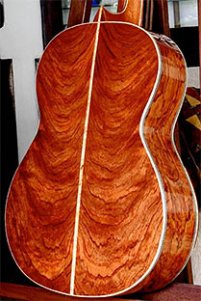
Weight: Medium Light
Wood Properties and Sound
See a Bellucci Bubinga Guitar HERE
Cocobolo
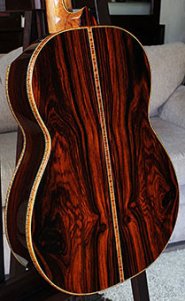
Weight: Medium Heavy
Wood Properties and Sound
See a marvelous Bellucci Cocobolo guitar here →
Almost identical to Brazilian Rosewood, can be called Brazilian rosewood younger brother. Liquid tone and great color palette. It is strikingly beautiful and the finished instrument can get anybody stunned.The sound is mysterious, deep and clear at the same time. Cocobolo is a hard and heavy wood with irregular grain with a medium fine texture which is a close relative of Brazilian Rosewood. They are both Dalbergias. It finishes fantastically and it offers some of the best looking figures any builder can dream of for a concert guitar. The palette of colors it displays ranges from black, brown, orange and yellow and I often thing of the best sunsets when I look at the grain of Cocobolo. The sound is warm yet brilliant and powerful. It makes Cocobolo stand out as one of the best tonewoods on the planet. Definitely one of my favorites.
Coyote (Mexican)
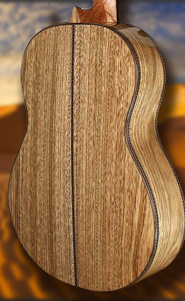
Weight: Light
Light and Loud
Coyote (The Mexican & the Paraguayan variety) are spectacular woods for both Flamenco and classical guitar construction. The wood is light and offers a stunning "fury look" that resembles the fur on a desert coyote. Coyote is light and finishes fantastically. It offers a crisp and deep sound that will suit all your musical needs. The sound Coyote offers to the player is well defined with crispy basses and perfectly balanced trebles. See a wonderful Bellucci Coyote here →
Gabon Ebony
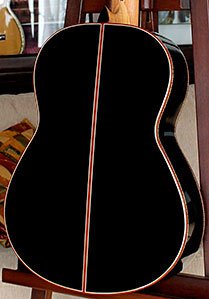
Weight: Heavy
Wood Properties and Sound
Gabon Ebony is the standard for black in lumber. It has been found in Egyptian tombs and is used on the fingerboard of violins. A very dense wood with specific gravity of 1.2, it is usually only available in widths less than 6” and lengths less than 48”. This is partly do to where the trees grow in central West Africa. There are few roads and most of the billets have to be hand carried out of the jungle. It is the rarest of the ebony woods. Very dense tight grained wood. If you think Zorro, this is the wood for the job. It finishes fantastically and makes every marquetry decoration stand out marvelously. Every guitar I built using Gabon Ebony produced a fabulous guitar with amazingly powerful bass, rich mid tones and ringing trebles. Sustain and projection are always off the charts. See a Bellucci Gabon Ebony Beauty here →
Granadillo
Weight: Heavy
Granadillo
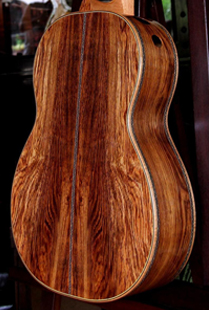
Granadillo is an exotic wood that is bright red to reddish or purplish brown, with rather distinct stripes. The sapwood is clearly distinct from the heartwood, and is almost white in color. It is hard and superior to Teak and probably Mahogany. The wood is exceptionally heavy. It weighs much more than Hard maple or Teak in the green or seasoned condition. The density of the wood is very high. The sound it produces is unbeatable and the separation of voices exceptional. See a Bellucci Granadillo Guitar HERE>>
Indian Rosewood
Weight: Medium
Wood Properties and Sound
See a marvelous Bellucci Indian Rosewood sample guitar here →
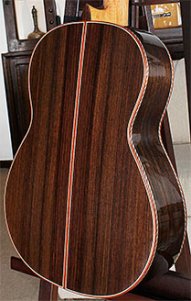
Indian Rosewood, is very stable, clear tone and good separation of voices. The most popular wood for classical guitar construction especially since Brazilian Rosewood has gone up in price. I call it the Volkswagen of tropical woods. Low priced and very stable. Makes for very "predictable" guitars. It offers great playing and looks without breaking the bank. Indian Rosewood has been used for guitar backs and sides for many decades. The sets I use are mostly imported from East India, Madagascar and Indonesia. Indian Rosewood has come into common usage starting in the mid 1960s when the more well known Brazilian Rosewood became less available in the quantities needed for large scale guitar production. High quality Indian Rosewood logs were plentiful and commercially available to the major markets when the Brazilian government stopped the export of Brazilian Rosewood logs. Fortunately, Indian Rosewood was also found to be an excellent alternative to Brazilian Rosewood both visually and tonally. Every guitar I build using East Indian Rosewood delivers an excellent tone with top notch projection, clarity and superb sustain. No wonder it is slowly and steadily becoming the most used tonewood for classical guitar construction on the planet.
Indonesian Rosewood
Weight: Medium
Wood Properties and Sound
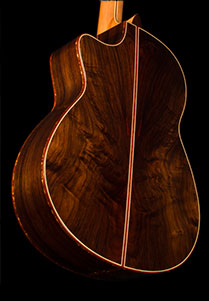
Indonesian Rosewood is a challenging tone wood to work with (see a Beautiful Bellucci Indonesian Rosewood Guitar HERE). It can cause havoc with tools because of its interlocked grain and density. Indonesian Rosewood Glues and finishes well, and a myriad tones of Browns, Oranges and reds can add drama to the looks of Indonesian Rosewood Guitars. The sound it produces is practically speaking Identical to East Indian Rosewood. Unlike the East Indian variety, the beauty and artistry that nature performs with Indonesian Rosewood is always to say the least striking. Great Tone, and separation of voices are typical of Indonesian Rosewood. Highly Recommended !
Kingwood
Weight: Medium
Kingwood, the name says it all
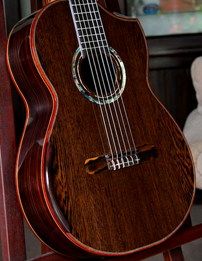
I use Kingwood mainly for the top because it possesses some of the best qualities of both Cedar and Sinker Redwood. The response of Kingwood is fast and the contrast it generates with the marquetry makes it a very desirable wood for the top of concert instruments. See a Kingwood Top beauty here →
Koa
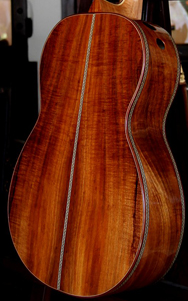
Weight: Light
Wood Properties and Sound
See a marvelous Bellucci Hawaiian Koa guitar here →
Hawaiian Koa has a clear warm sounding basses and crystal clear trebles. Similar tone characteristics as Bubinga and Tasmanian Blackwood. Tone wise, it is particularly striking when built as a Double top. The wood presents a gorgeous grain. This amazing Hawaiian species is steadily becoming one of the most sought after Tropical tonewoods on the planet. Its grain is always stunning and it always delivers amazingly sounding concert instruments. Still, I find it a little overpriced considering that Black Limba or Goncalo Alves produce similar results at lower price. Still, it is a wood in vogue and if it were not so expensive, it would definitely be among my favorites tropical tonewoods.
Lacewood
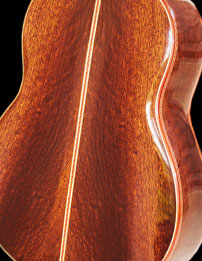
Weight: Medium
Lacewood Characteristics
Lapacho
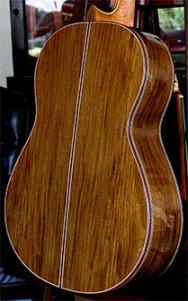
Weight: Medium
Wood Properties and Sound
See a Beautiful Bellucci Lapacho Guitar here →
Laurel California
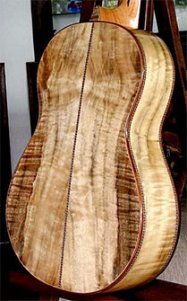
Weight: Light
Wood Properties and Sound
Laurel is a wonderful species that is found throughout the Americas. The California variety is particularly beautiful. It possesses a tremendous tap tone and always produces top of the line guitars. It is relatively cheap when compared to woods that deliver similar sound at much higher costs like Blackwood or Brazilian rosewood. Some sets also offer a stunning grain although the norm is that the figure is mos times moderate. The set displayed here is the standard look of California Laurel. The sound is vibrant and lively. The bass rings generously and is accompanied by rich overtones, mid ranges and brilliant trebles. Perfect sound ! Laurel works marvelously well with Spruce, Cedar and Redwood. I never used it in conjunction with Port Orford Cedar but I am sure it must deliver a terrific instrument. See a Laurel California Bellucci Guitar here →
Macassar Ebony
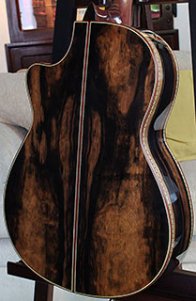
Weight: Heavy
Wood Properties and Sound
See a marvelous Bellucci Macassar Ebony guitar here →
Macassar Ebony possesses a deep clean basses and great sustain preferred to Brazilian rosewood by many guitarists and builders. It is sober and generates a full, round sound. It projects very well and possesses a one in a million sustain. The figure of the grain can be quite striking. In the same league with Brazilian rose, African Blackwood and Maple. Some of the most striking instruments are made with this Indian species. If you love dark looking instruments, this is definitely the wood for you. The sound you can expect from Macassar Ebony is simply phenomenal with clear penetrating trebles accompanied by the best defined, well rounded basses you can dream of. Sustain and projection are naturals for this tremendous tonewood species that ranks by far as one of my all time favorite guitar tonewoods. Macassar Ebony was made famous by the Indonesian Variety and the one proceeding from the island of Makassar, but the species is harvested throughout South East Asia and even many African Countries. The figure of Macassar Ebony varies A LOT from one tree to the next and the geographical location also has a big impact. I generally purchase my sets based on the figure grain) rather then the place whee it. With custom orders I try to come as close to my customers' request regarding grain and color.
Madagascar Rosewood
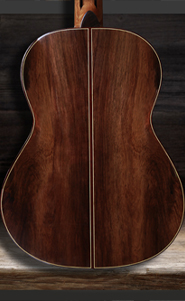
Weight: Medium Heavy
Wood Properties & Sound
Mango
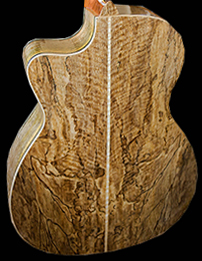
Weight: Medium Light
Wood Properties and Sound
Mango is a tremendously resonant wood. When it is figured as the spalted variety is, it is simply stunning. I usually build the "Anaconda" guitar model when I use the spalted variety. Mango is light and tremendously sonorous. HERE >> you can see a stunning Mango Jumbo Acoustic guitar I custom built for my friend Marcus. Working with Mango wood allows for some splendid marquetry work both in wood and/or in pearl or abalone. Normally, the Mango I use comes from Indonesia and the Island of Madagascar.
Maple
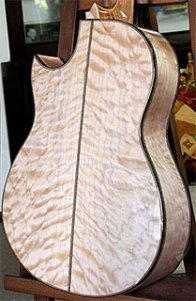
Weight: Light
Wood Properties and Sound
I could go on for hours writing about this glorious tonewood.Maple possesses a well balanced sound on all 6 strings, in my opinion, one of the best tone woods to the point that I cannot believe that it is not more sought after. It really competes neck to neck with Brazilian rosewood and African Blackwood, and the wood looks simply terrific. The great advantage of the species is that it is an American species, which translates in very little care when it comes to humidity conditions etc. It is very light compared to the tropical species but delivers with the same presence. It is one of the most beautiful woods and makes beautiful guitars. When it comes to looks, I do not think that there is another wood that can shine as majestically s Maple does. All Bellucci Maple guitars deserve the "Queen guitar" coronation.
Monkey Pod
Weight: Medium Light
Wood Properties and Sound
See a marvelous Bellucci Monkey Pod guitar here →
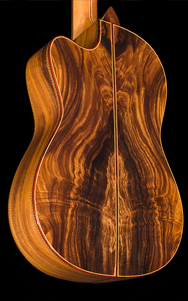
I was able to snap a few amazing sets of Monkeypod from Indonesia late in 2012. I am amazed at the beauty of the figure and the gorgeous sound that the wood generates. It is full of harmonics with an outstanding presence of the bass and very well balanced and brilliant trebles. The color tends to be a golden and moves towards dark brown, sometimes with black streaks. Sapwood is usually thin and yellow/white, clearly demarcated from the heartwood. Monkeypod is sometimes seem with highly figured curly or wild grain patterns that make me think of a "gently stirred Cappuccino". It receives different names in different regions of the globe and is comparable in acoustic properties to Koa and Tasmanian Blackwood. Definitely one of the most dramatic looking woods on the face of the Earth.
Moon Ebony
Weight: Heavy
Wood Properties and Sound
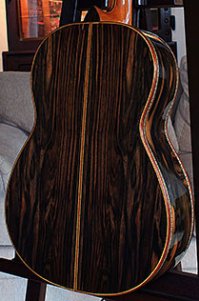
See a Beautiful Bellucci Moon Ebony Guitar HERE
Oak Tasmanian
Weight: Medium
Wood Properties and Sound
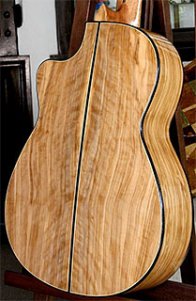
Tasmanian Oak has proven to be a top of the line wood when it comes to concert instrument construction. It is not always readily available. The Tasmanian variety is extremely rare. It produces a full sound full of harmonics and it ranks with the best tonewoods woods on the planet. It looks gorgeous and works perfectly with Spruce, Cedar or Redwood. The bass is characterized by a tremendous punch accompanied by a stunningly clear and penetrating treble. Sustain and projection make Oak rank among the royalty of Tropical tonewoods. The beauty and elegance of the grain are also stunning and Tasmanian Oak is among those tonewoods that finish tremendously well.
Padauk
Weight: Medium Heavy
Wood Properties and Sound
See a marvelous Bellucci African Padauk guitar here →
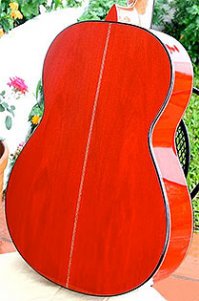
Big sound with penetrating basses, fast response and clear trebles. Very similar to the Rosewoods. Sustain and projection are amazing making it one of my favorite tonewoods. The reddish tone makes it a great favorite among the lovers of this color. Every Padauk guitar I built to date has been a head turner. The sound is rich in overtones and it is among the best woods in its price range which is considerably small when it is compared to woods in the same league. It is one of the woods that shines the best when it is finished. Padauk oxidizes to a darker, rich purple-brown over time - although it stays redder than the Rosewoods. It is slightly harder and heavier than Indian Rosewood it is a good back and side wood in all respects - stable, easy to work, with a strong tone. Some consider Padauk to be the most promising replacement for generic Rosewood. It may be a little difficult to bend compared to the ease of bending of some of the more pliable woods.
Palo Escrito
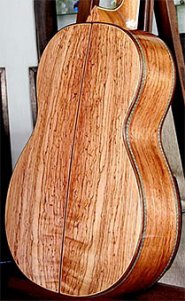
Weight: Medium Light
Wood Properties and Sound
Palo Escrito is a top notch tone wood from Central America. It booms like the most expensive woods but at a fraction of the price. It is very stable and has a sparkling sound. I highly recommend this wood. Palo Escrito is the premiere native back and side wood used by most builders in Mexico and throughout Central America. It is a true Rosewood, but differs from Indian Rosewood visually with slightly wider grain, more figure resembling curly red hair, and an overall lighter color. It is also lighter in weight. Palo Escrito is moderately priced each set is uniquely striped. The bass delivered by Palo Escrito is top notch. The mid ranges sing marvelously offering a perfect background for the trebles. Sustain and Projection make it rank with the Royalty of tonewoods. Click here → for a wonderful Palo Escrito Bellucci guitar
Pau Ferro
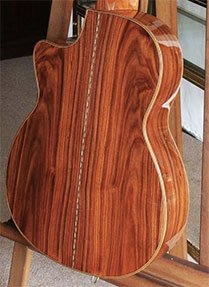
Weight: Medium Heavy
Wood Properties and Sound
See a marvelous Bellucci Pau Ferro guitar here →
Well Balanced sound, good volume and perfect balance of voices. Quick response. Possesses all the characteristics of the more best Tropical tonewoods. Pau Ferro offers great presence in the sound making it an ideal choice for Classical, Bossa Nova & session musicians that need warmth, introspection and good separation of voices. It finishes marvelously well and is very stable and resonant. Pau Ferro often presents itself with wonderfully striped grain. It is one of my favorite Tropical species. Unlike Brazilian Rosewood and other ''high maintenance'' woods, Pau Ferro needs very little or no pampering when it comes to humidity control etc. It is without any doubt one of my all time favorite Tropical tonewoods.
Primavera Wood
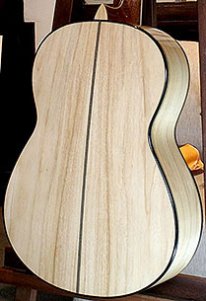
Weight: Light
Wood Properties and Sound
See a marvelous Bellucci Primavera guitar here →
Primavera (Spring) is a gorgeous tonewood found in most of Latin America. Mexico, Nicaragua, Guatemala, El Salvador, North and central Honduras. It is amazingly beautiful and I find it ideal for light guitar construction. It is far better than Cypress when comes to the Flamenco sound but the great side to this wood is that it performs fantastically well in Classical music as well making it my top choice for Flamenco & Classical Construction. The wood possesses the aggressive tone of the Cypress family of trees and the warmth of the dark African species and the combination of these brings about some of the most spectacular instruments you can dream of. Tap tone is marvelous and Primavera delivers a deep resonating bass with lively mid ranges and the most clear trebles you will ever hear.
Purple Heart
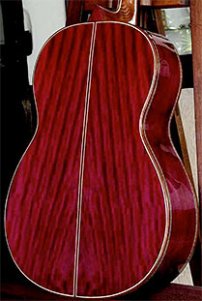
Weight: Medium Heavy
Purple Heart Characteristics
Purple Heart has turned out to be one of my all-time favorite tonewoods. Not only is the grain stunning to look at but the sound it delivers is second to none. Purple Heart finishes tremendously well and it is an eye candy. When it comes to sound, it is in the same league as Koa, Macassar Ebony & Maple. See a stunning Bellucci Purple Heart Concert Guitar HERE>>
Quilted Mahogany
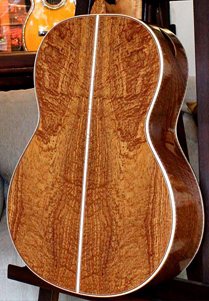
Weight: Medium
Wood Properties and Sound
Quilted Mahogany is one of the most Striking Woods both visually and sound-wise. See a Quilted Mahogany Guitar HERE>>
Snakewood
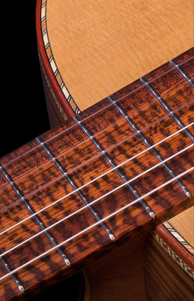
Weight: Medium Heavy
Wood Properties and Sound
See a Beautiful Bellucci Snakewood (AKA Lacewood) Guitar HERE
Spanish Cypress
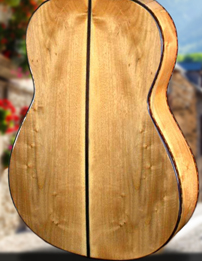
Weight: Light
Flamenco Cypress Guitar
Tamarind
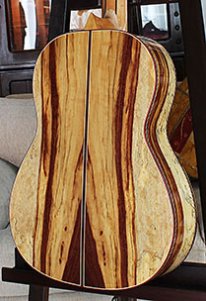
Weight: Medium
Wood Properties and Sound
See a marvelous Bellucci Spalted Tamarind guitar here →
Spalted Tamarind is a native wood of tropical Africa; It is also widely planted throughout other tropical regions in South America. It presents itself in a stunning variety of figures that allow the luthier to express himself to the highest levels of artistry. In the sound, you can appreciate the perfect vibrato generated by the first string, the perfectly balanced second and third strings and the supporting bass that creates the perfect background onto which all the other voices shine. You can also admire her expressive power and the stunning the presence of the bass. The looks of this stunning Tonewood are beyond the realm of words. Deep dark brown stripes contrast beautifully with the clear background canvas color that Tamarind offers. A stunning Tonewood.
Tasmanian Blackwood
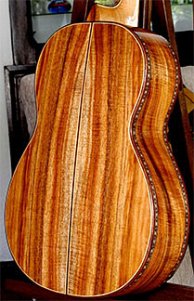
Weight: Heavy
Wood Properties and Sound
See a marvelous Bellucci Tasmanian Blackwood guitar here →
Superb species from Southern Australia. It ranks high up with African Blackwood only it is scarce and hard to come by. The looks and sound of Tasmanian Blackwood guitars are among the best that can be produced on a classical guitar. The grain varies quite a bit from one tree to the next but the sonorous properties are very consistent and always top of the line. It is very similar to Hawaiian Koa and possesses most of the qualities of the Hawaiian species. Tap tone is always stunning and it shows in the big round basses it can generate and some of the best trebles in guitar construction. The separation of voices is outstanding and the wood can define each one of the voices to unsuspected levels of clarity.
Tasmanian Tiger Myrtle
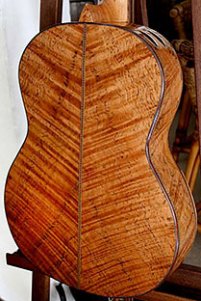
Weight: Medium Heavy
Wood Properties and Sound
See a gorgeous Tiger Myrtle Guitar here → Tasmanian Tiger Myrtle is perhaps the best discovery I made in 2010 when it comes to tonewoods. This Australian wood from is sure to get a lot of attention. The color ranges from light reddish beige to pinkish-purples and is sometimes reminiscent of Pink Ivory. Some sets have attractive brown streaks and others have gray-brown sapwood centers. It has a prominent and robust tap tone. It bends extremely well and finishes to a high luster. Not only is the grain spectacular but the sound the instrument puts out is tremendous with big bass lines, clear trebles and a separation of voices worthy of the highest ranking tonewoods on the planet.
Walnut African
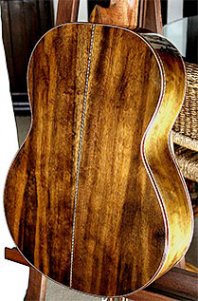
Weight: Medium Heavy
Wood Properties and Sound
See a Beautiful Bellucci African Walnut Guitar HERE
Wenge African
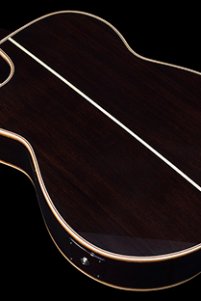
Weight: Medium
Wood Properties and Sound
See a marvelous Bellucci African Wenge guitar here →
Wenge, also known as Kingwood is a native of Cameroon, Congo, Gabon, Mozambique, Tanzannia and Zaire and can very proudly and justily carry the name of "king" due to its magnificent acoustic and aesthetic virtues. It can produce guitars in the same league and quite same external appearance as African Blackwood. The main difference is that Blackwood is way more expensive but the resulting guitars are very much in the same league. It is not as heavy as Blackwood yet it delivers some stunning guitarscharacterized by deep, well defined basses and superb trebles and mid ranges that shine and stand out for presenting one of the best separation of voices anyone can dream of on a concert guitar.
Zebrawood
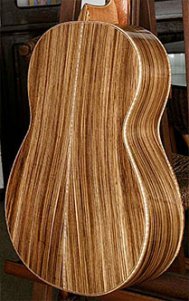
Weight: Medium Light
Wood Properties and Sound
See a Beautiful Bellucci Zebrawood Guitar HERE
Ziricote
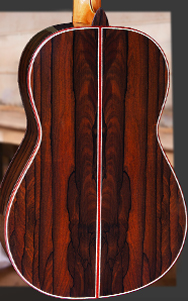
Weight: Heavy
Wood Properties and Sound
See a marvelous Bellucci Ziricote guitar here →
Big deep sound in the bass, clear trebles, similar to Macassar Ebony and Brazilian rosewood, stunning to look at and one of my favorite woods. The grain is simply dramatic and some of the most beautiful instruments are made with Ziricote. The grain is always wild and it seems that nature hired a world class artist to design its magnificent grain. It is simply stunning to look at and produces top of the line guitars. The sound it generates is among the most desired ones for the Classical, Baroque and Romantic repertoire. Ziricote produces amazingly rich basses, tremendously clear trebles and possesses one of the most prominent sustains and projections among the Tropical tonewoods.