Back to Top


Tárrega Francisco, "Capricho Arabe" (TAB)
Transcription and Fingering: Renato Bellucci
Tárrega wrote some of the best classical guitar pieces. He knew the guitar thoroughly. His work must be revised because of the type of instrument, strings and technique used by the Spanish master. Tárrega used fingernails until the last nine years of his life. In 1900, Tárrega withdrew from doing concerts and started to play with the flesh. Pujol described Tarrega's use of the flesh as giving a clear sound because of the "width, smoothness, and firmness of the body that set the strings vibrating. This certain touch must be developed". Pujol added, echoing Fuenllana, that "the flesh best transmits the feeling of the soul, such an unresponsive medium as nails interferes, somehow with the direct contact of the artist's sensibility to the string". Read more on the nail VS no nail controversy here.
Capricho Arabe is an enormous piece. Over 700 years of Moorish occupation of the Iberian peninsula (Spain) have left a huge, eternal mark. 700 years is longer than Europeans have been in the Americas to date. The guitar as an instrument was brought in by the Arabs and became Spain's instrument. Although the 2 cultures never really mixed and the 2 monotheistic religions showed respect for one another, it is in music and a few Spanish words (for instance, all Spanish words containing AL -almohada = pillow, alcoba = bedroom- are of Arabic origin) that the best of the 2 cultures comes together.
Great players have recorded this work many times and although many think it is difficult to play, it is not. The scales have to be examined technically before playing them and they are not meant to be played fast. Showing off is for immature souls with little or nothing meaningful to say.
What you hear in a recording cannot be reproduced in a ''real'' musical scenario like a concert for friends, family or unknowns. Remember:Nobody claps intentions... "I meant to play it like Segovia but.. damn! It did not work". This piece is magical and it needs deep understanding of each musical phrase. Leave nothing to chance. Practice time is ''the music lab'', the place where you, the wizard, mix the ingredients. Take all the time in the world and play slow enough not to allow mistakes to enter your practice. It is not mandatory to make mistakes!
Staff and Video 1
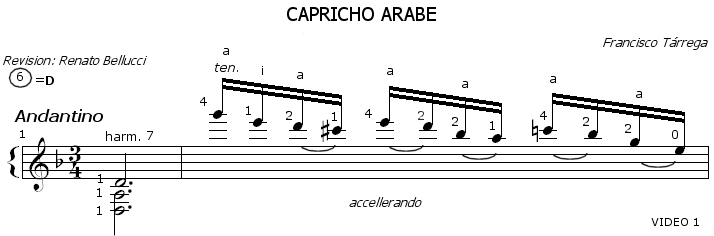
6=D means that string 6 is tuned down from a low E to a low D.
Analysis:
Play the 2 initial notes. The scale is meant to be played adding a smooth accellerando. The challenge is to move to the new position for the 3 stages of the scale. 1: play G E 2: change left hand position 3: play D C# E D 4: change left hand position 5: play Bb A C Bb 6: change left hand position 7: play G E. Divide this scale and focus on the position change and do not rush it. Avoid mistakes during practice at all cost.
Regarding the right hand fingering, it is important that you make it as consistent as possible. Whenever possible, I like to use the same finger on a given string for sound uniformity but it is alright to alternate fingerings should you feel more comfortable doing so. Write down the right hand fingering.

In scales, keep the left hand knuckles parallel to the fingerboard
Video 1
The continuation of this masterclass is in the members area, become a member today.